
When we provide or receive a service, what is the first thing we ask for?
Feedback.
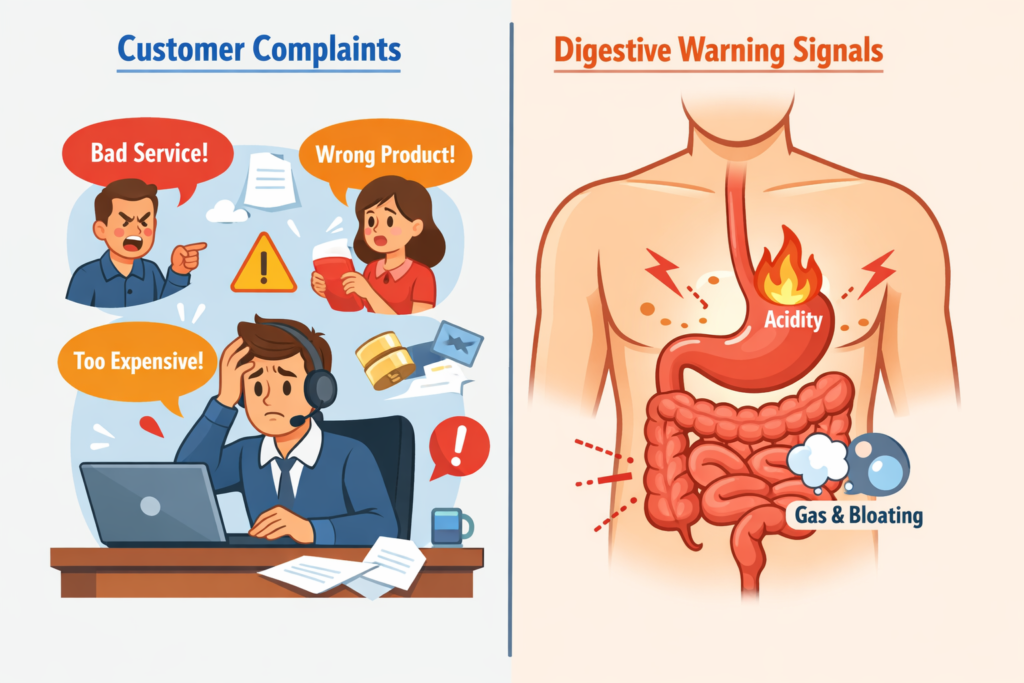
Businesses rely heavily on feedback to improve their products and services. If a customer complains about a defective product, the company investigates the issue, fixes the production process, and prevents the problem from recurring.
But imagine a business that ignores every complaint.
Eventually, customers stop trusting the brand, sales decline, and the business collapses.
Now ask yourself an important question:
When your body sends signals like acidity, gas, or bloating — are you listening to the feedback?
Or are you simply suppressing the symptoms with medication?
The Body: A Highly Intelligent Communication System
The human body is one of the most sophisticated communication systems ever created.
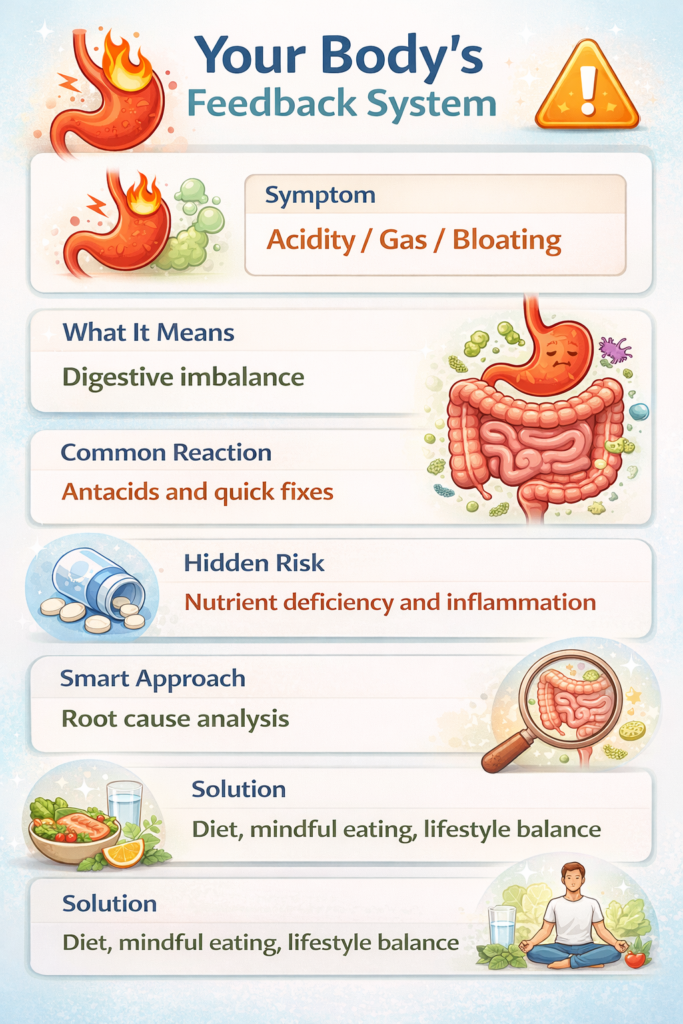
Symptoms such as acidity, gas, and bloating are not random errors. They are actually biological messages telling us something about our internal environment.
Common digestive feedback signals
Acidity
Often indicates:
- Poor food combinations
- Overeating
- Excessive spicy or processed food
- Chronic stress
- Poor chewing habits
Gas and Bloating
Frequently signals:
- Improper digestion
- Fermentation of undigested food
- Gut microbiome imbalance
- Eating too fast
- Food intolerances
These symptoms are essentially the body’s diagnostic reports.

The Problem: Muting the Messenger
In modern life, the most common response to digestive discomfort is simple:
Take a pill and move on.
Medications such as antacids or proton pump inhibitors (PPIs) provide quick relief.
But what are they actually doing?
They are silencing the messenger without solving the problem.
This is similar to a company deleting customer complaints instead of fixing product defects.
What happens when symptoms are constantly suppressed?
Long-term suppression can lead to:
- Poor nutrient absorption
- Reduced Vitamin B12 absorption
- Calcium deficiency
- Gut microbiome imbalance
- Chronic inflammation
Stomach acid, contrary to popular belief, is actually essential for digestion and nutrient absorption.
Reducing it repeatedly without addressing dietary causes may create deeper problems over time.

From Temporary Relief to Chronic Disease
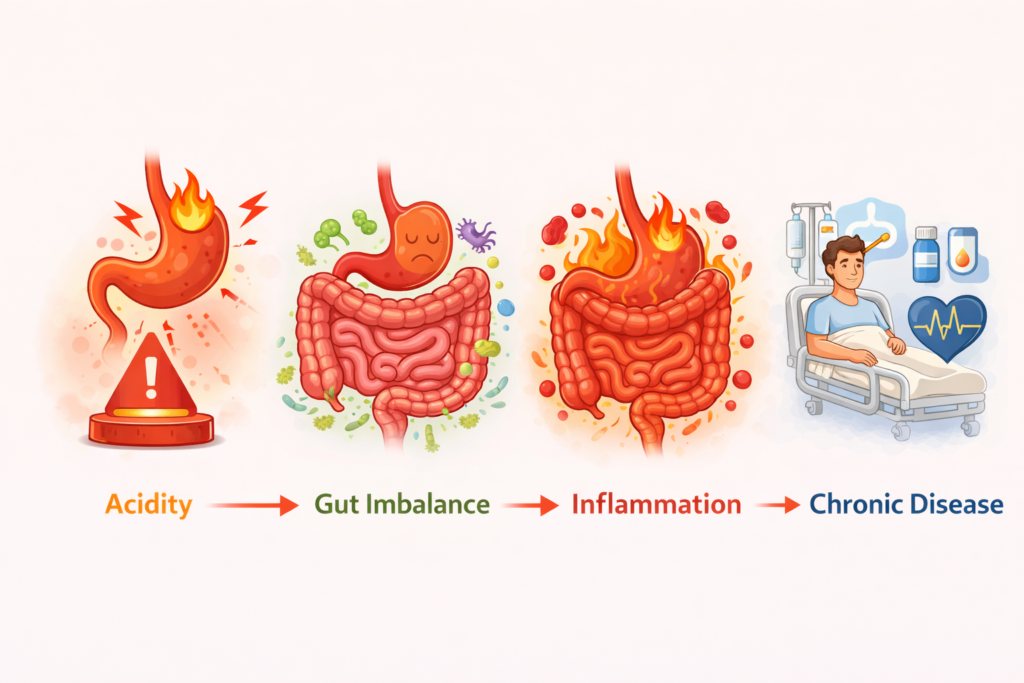
Ignoring repeated digestive feedback can slowly push the body toward chronic health problems.
Scientific research increasingly connects gut dysfunction with systemic diseases.
Potential long-term consequences include:
- Chronic inflammation
- Microbiome imbalance (dysbiosis)
- Leaky gut syndrome
- Metabolic disorders
- Autoimmune conditions
The gut is not just a digestive organ—it is deeply connected to the immune system and overall metabolic health.
The Root Cause Approach: Listening to Your Body
Instead of suppressing symptoms, the smarter approach is Root Cause Analysis (RCA).
Just like a business investigates complaints to improve operations, we must investigate our body’s feedback.
Ask three important questions
1. Input — What did I eat?
- Highly processed foods
- Excess sugars
- Overeating
- Poor food combinations
2. Process — How did I eat?
- Eating too quickly
- Poor chewing
- Distracted eating (phones, TV)
3. Environment — What was my mental state?
Digestion works best in the “rest and digest” mode.
Eating while stressed keeps the body in fight-or-flight mode, which suppresses digestive function.

Natural Support for Digestive Balance
Instead of suppressing symptoms, natural approaches aim to support digestion and correct imbalances.
Traditional systems of health have long used simple dietary tools.
Examples include:
- Coriander water to support digestive cooling
- Coconut to soothe digestive lining
- Slow, mindful eating to improve enzyme release
- Reducing processed foods to support gut bacteria
Small lifestyle changes often create large improvements in digestive health.

Business Lesson for Health
Think of your body like a company.
| Business Scenario | Biological Reality |
| Customer complaint | Acidity or gas |
| Quick refund | Antacid tablet |
| Ignored product defect | Poor diet continues |
| Business failure | Chronic disease |
| Root cause analysis | Lifestyle correction |
The lesson is simple:
Symptoms are feedback — not enemies.
Listening to them early can prevent serious health problems later.
Key Takeaway
Your body is constantly communicating with you.
Acidity, gas, and bloating are not random disturbances—they are important biological messages.
Instead of suppressing them repeatedly, take a moment to ask:
What is my body trying to tell me?
Listening to these signals may be the simplest step toward long-term health.
Medical Disclaimer
This article is intended for educational and informational purposes only. It is not intended to replace professional medical advice, diagnosis, or treatment. Always consult a qualified healthcare professional before making changes to your diet, lifestyle, or medication.
Author Section
Author: Ram Niwas Bansal
Ram Niwas Bansal writes about preventive health, naturopathy principles, and lifestyle-based healing. Through the Tandurusti Health platform, he aims to simplify complex physiological concepts and connect traditional wisdom with modern health science to promote long-term wellness.