
Table of Contents
Introduction
BG 5.18 meaning: In our daily lives, we often encounter stray animals on the streets. Sometimes they are seen panting heavily in the scorching heat, while at other times they sit quietly in a lonely corner, looking utterly dejected. Recently, I had the opportunity to closely observe two stray dogs resting near a garden gate.

Seeing them so tired and helpless, a profound thought naturally flashed through my mind: Are they repenting for the misdeeds of their past lives? Is this helplessness the fruit of their past karmas? When we witness the silent suffering of these mute creatures, our inner conscience is deeply stirred.
To understand this deep philosophy of life, when we turn toward ancient spiritual wisdom, the BG 5.18 meaning provides us with an entirely new and divine perspective.
Bhagavad Gita Chapter 5, Verse 18 (BG 5.18) and Its Deeper Significance
BG 5.18 meaning: While explaining the path of knowledge (Jnana Yoga) to Arjuna, Lord Krishna delivers an extraordinary teaching on ‘Equal Vision’ (Samadrishti) in the 18th verse of the fifth chapter:
विद्याविनयसंपन्ने ब्राह्मणे गवि हस्तिनि ।
शुनि चैव श्वपाके च पण्डिताः समदर्शिनः ॥
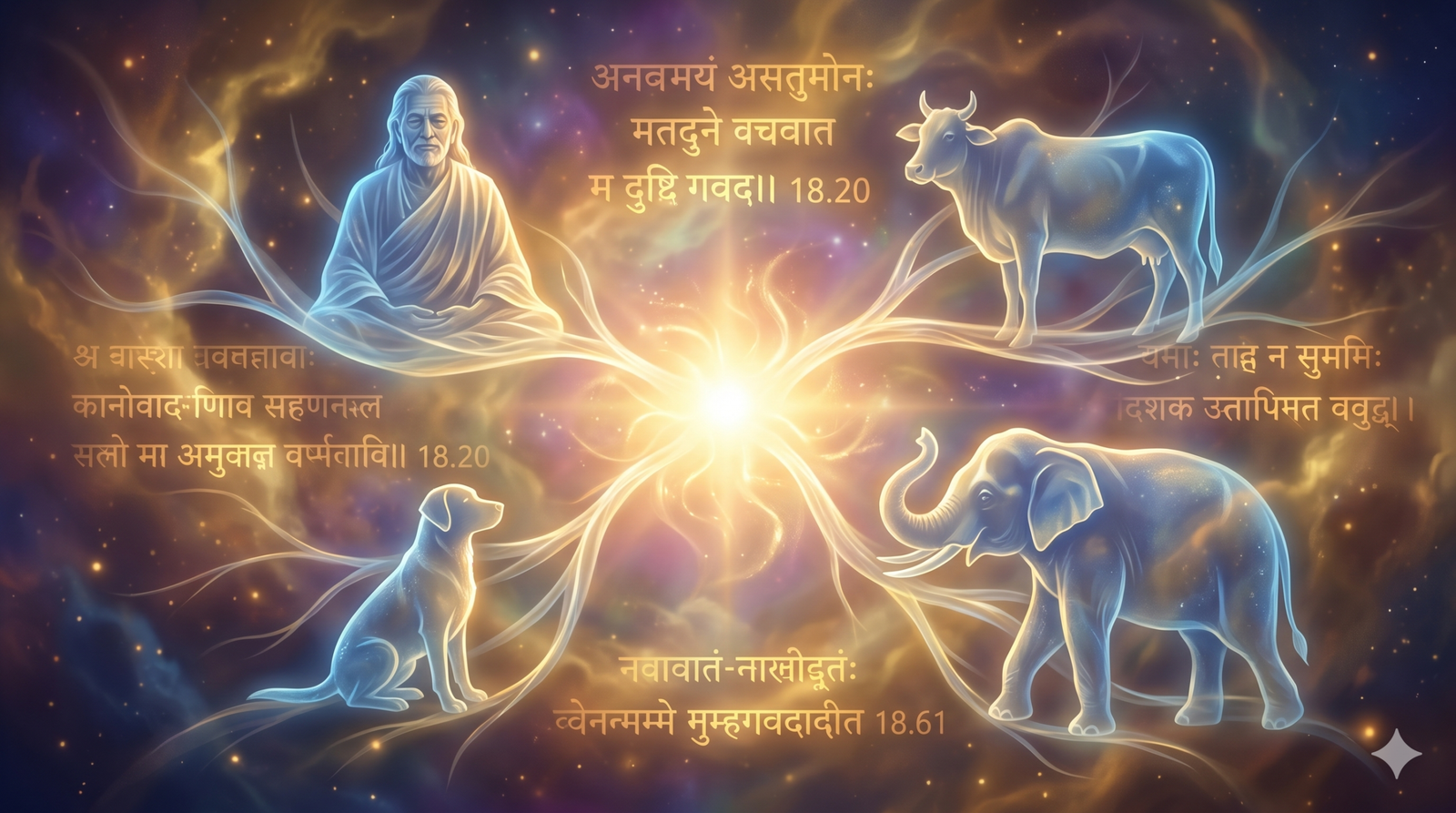
The humble sages, by virtue of true knowledge, see with an equal eye a learned and gentle brahmana, a cow, an elephant, a dog, and a dog-eater (outcaste).
Lord Krishna is explaining here that true knowledge is not something that separates us from others; rather, genuine wisdom is that which enables us to perceive the same eternal spark of God—the soul—hidden within every living being. The external bodily structure is merely an outer garment; the true essence is the consciousness residing within.
A Simple and Precise Analogy: The Principle of Vehicles and Engines
BG 5.18 meaning: We can understand this profound spiritual law through a highly practical and logical automobile analogy.
Consider the various vehicles running on the road. We might see a small moped, a luxurious sedan, a heavy-duty commercial truck, or a superfast racing car. The external appearance, model, weight, and engine capacity (CC) of all these vehicles are completely different from one another.
But does their basic principle alter? Not at all!
- The fundamental engine function remains exactly the same across all of them.
- Every vehicle derives its energy through internal combustion and the movement of pistons.
- Every vehicle requires fuel to move forward.
A small scooter can easily navigate through narrow alleys, but it cannot carry heavy loads like a truck. On the other hand, a heavy truck can haul massive cargo, but it cannot match the speed of a racing car. This variation belongs to the vehicle’s model and its capacity, not to the foundational principles of motion and mechanics.
In exactly the same way, among all living creatures in this universe—whether it is a tiny ant, that sorrowful dog sitting on the street, or we intelligent human beings—the energy of the ‘soul’ and its source remains identical. The only variation lies in our physical body shapes and our respective brain capacities. Just because the model of the body changes, the fundamental nature and divinity of the soul sitting inside do not change.
Bhoga Yoni vs. Karma Yoni: The Test of Humanity
BG 5.18 meaning: In our scriptures, animal life is referred to as ‘Bhoga Yoni’ (the body of experiencing/reaping). This implies that animals take birth in those bodies solely to exhaust the ledger of their past karmas. They do not possess the free will to create new karmas (sin or virtue); they merely experience their destiny. Therefore, when we see them in distress or helplessness, it is part of their past cycle.
On the other hand, we humans exist in ‘Karma Yoni’ (the body of action). We have been blessed with the freedom to think, understand, and choose our actions. Consequently, the helplessness of these mute animals is actually a test for us humans. It is a trial of our ‘compassion’ and ‘spirit of service’. If we walk away after seeing their pain, we are failing in our core human duty.
Bringing This Wisdom into Practical Life
The BG 5.18 meaning is not meant just for textbook reading; it must be integrated into our behavior:
- Compassion and Aid: Especially during the harsh summer season, make it a point to place a clean bowl of drinking water outside your house or in society corners for these voiceless animals.
- The Vision of Equality: Instead of shooing away an animal or viewing it merely as a ‘beast’, remember that the same conscious element lives within it that lives within you. Respect the soul hidden behind their silent eyes.
Conclusion
BG 5.18 meaning: Encountering those two dejected dogs on the street was not a mere coincidence; it was a message from nature reminding us of our duties as human beings. Bhagavad Gita verse 5.18 teaches us that at the spiritual level, we are all interconnected. When we help a mute creature, we are not just aiding an animal; we are serving a fragment of the Divine itself.
Ram Niwas Bansal
“Dedicated and highly qualified professional with a specialized focus on Cooperative Housing Society (CHS) Management and Legal Advocacy. Leveraging a strong technical background and an Indian Air Force veteran’s discipline, I provide end-to-end solutions for housing societies in Mumbai.
With a Government Diploma in Cooperation and Accountancy (GDCA) and a Diploma in Naturopathy, I bridge the gap between administrative excellence and holistic community well-being.
Disclaimer
The views expressed in this article are based on a personal and spiritual analysis of the philosophical verses of the Bhagavad Gita (BG 5.18). The objective is not to hurt anyone’s sentiments but to promote compassion, empathy, and humanitarian values toward all living beings.
Frequently Asked Questions (FAQs)
Q1. What is Equal Vision (Samadrishti) according to the Bhagavad Gita?
Ans: According to Bhagavad Gita (BG 5.18), equal vision means looking beyond the external bodily forms and social statuses of all living beings (humans, animals, birds) to perceive the identical spark of the Supreme Divine—the soul—within everyone.
Q2. Do animals have the same soul as humans?
Ans: Yes, according to Sanatan philosophy, the soul is indivisible and eternal. The differences among living beings arise due to their inherent gunas (modes of nature), their physical body shapes, and their brain capacities, but the fundamental element of the soul is identical in all.
Q3. Why is animal life called ‘Bhoga Yoni’?
Ans: In the animal form, living beings do not possess the intellect or spiritual discrimination to perform conscious moral actions. They only reap the fruits of their past deeds. The authority to perform fresh karma belongs exclusively to the human form (Karma Yoni).