
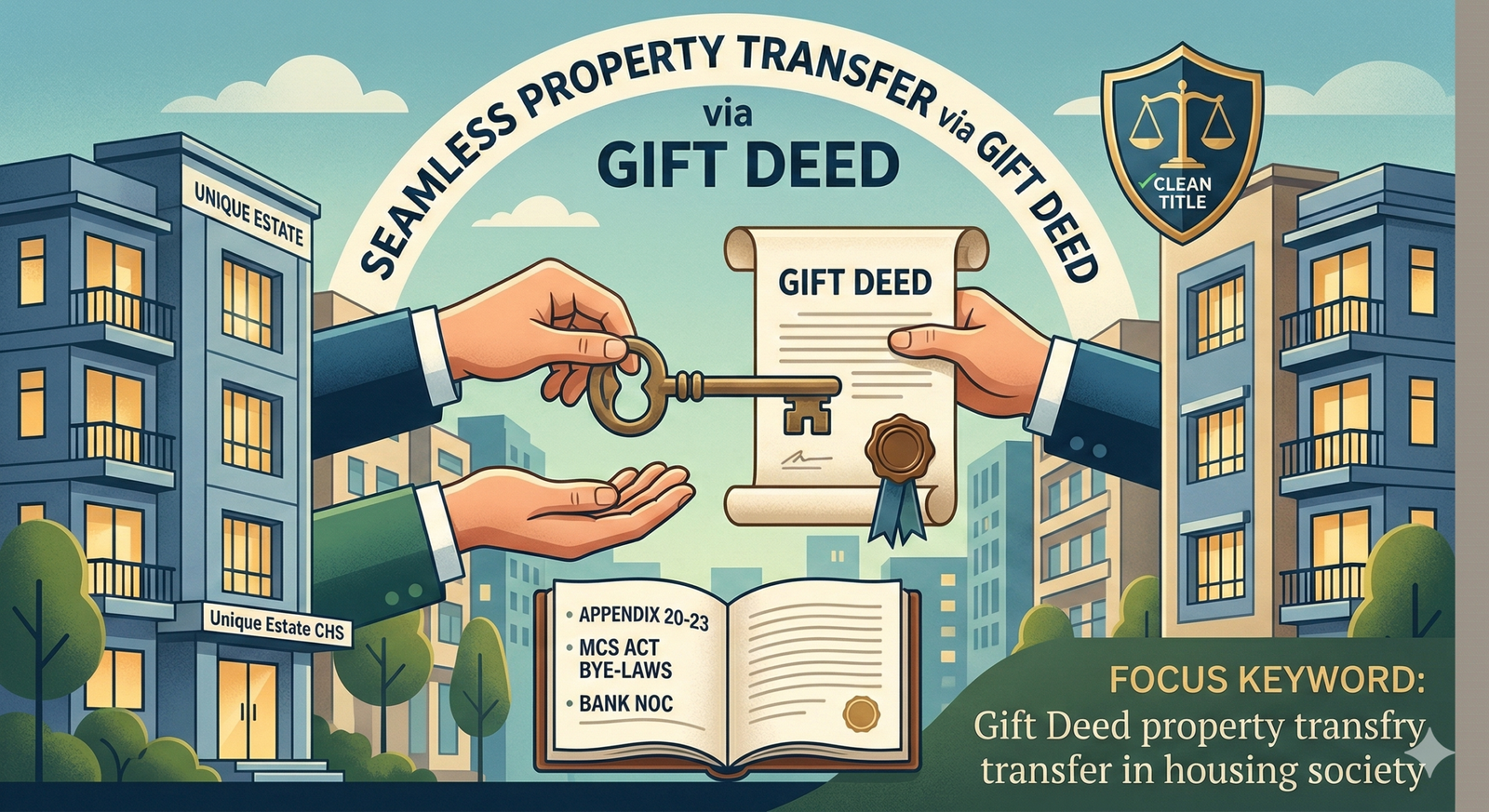
Table of Contents
Introduction
Gift Deed Property Transfer in Housing Society: Transferring a flat or property to a loved one through a registered gift deed is a significant milestone. In Maharashtra, while the emotional value of such a gesture is high, the legal transition must adhere strictly to the Maharashtra Co-operative Societies (MCS) Act 1960 and the Model Bye-laws. For a successful Gift Deed property transfer in housing society, both the donor and the society committee must follow a prescribed legal path to ensure a clear and undisputed title transfer.
💡 Real Reader Query: Can a Society Charge ₹25,000 Transfer Fees for a Family Gift Deed?
The Question: “I am gifting my flat to my son through a registered Gift Deed. The society committee is demanding a ₹25,000 transfer premium to update our share certificate. Is this legally allowed?”
The Legal Reality: No, absolutely not. As per the Model Bye-laws of Maharashtra Housing Societies (specifically Bye-law No. 38), a Co-operative Housing Society cannot charge a transfer premium for property transfers done within immediate family or blood relations via a Gift Deed. If your society insists on charging this fee for a family transfer, it is a direct violation of government circulars. They can only charge nominal administrative track fees (usually around ₹500) for processing the share certificate entry.
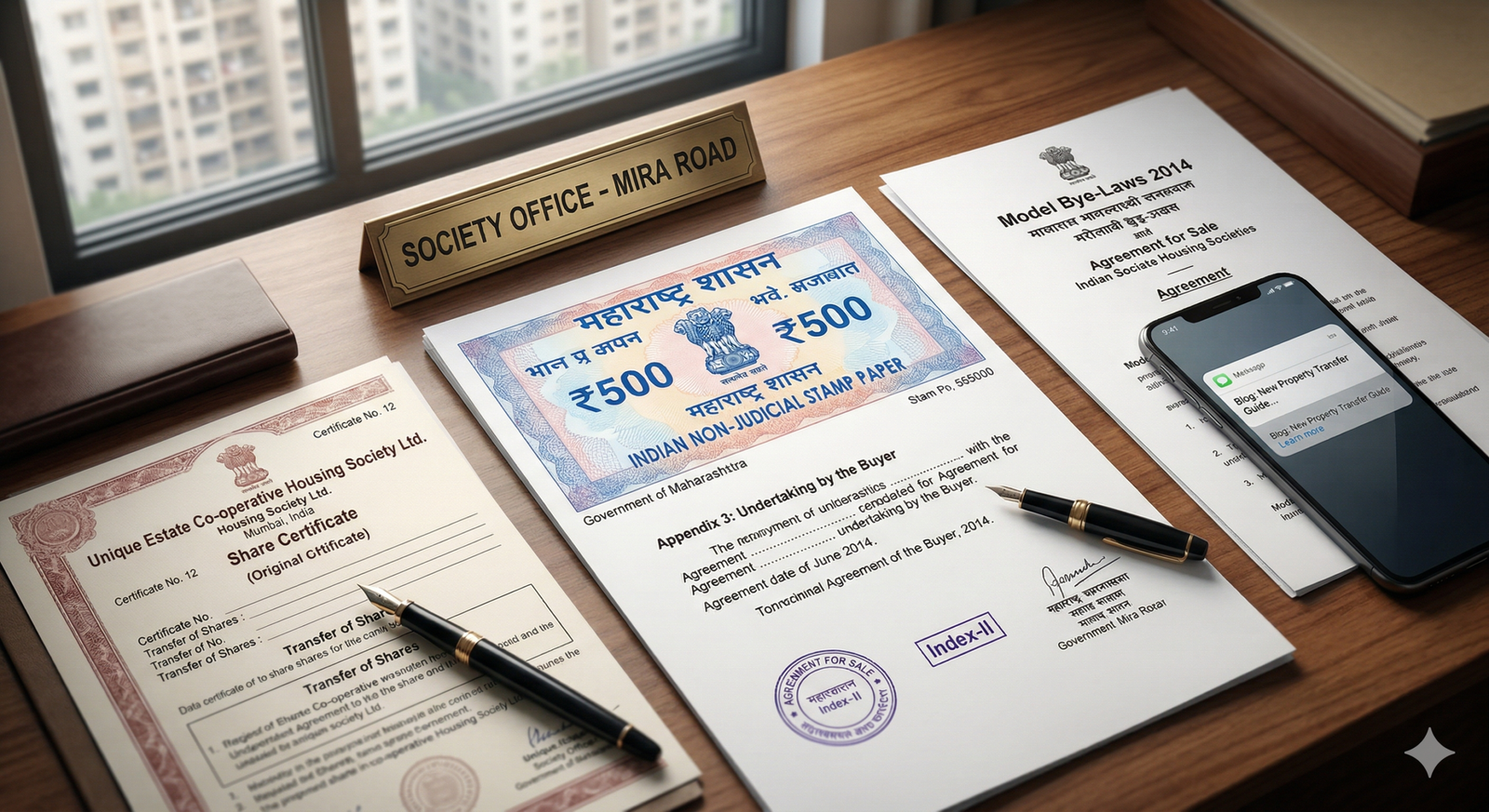
Understanding the Gift Deed
Gift Deed Property Transfer in Housing Society: A Gift Deed is a legal instrument used to transfer ownership of immovable property without any monetary consideration. Under the Transfer of Property Act, 1882, for a gift to be valid, it must be registered with the local Sub-Registrar of Assurances. In Maharashtra, Gift Deeds favoring “Blood Relatives” enjoy a drastically reduced stamp duty structure, making it an ideal estate planning tool for families looking to secure their property line smoothly.
🛡️ Essential Legal Safeguards: Conditional Gift Deed Clauses (For Parents & Spouses)
While transferring a housing society flat out of love and affection is a popular estate planning strategy, executing an unconditional Gift Deed can leave the Donor vulnerable to unexpected family disputes.
Under Indian property laws, once a gift deed is registered, ownership shifts completely. However, you can protect your residence and living rights by inserting specific legal conditions prior to registration.
Case 1: Parents Gifting Property to Children (Senior Citizens Protection)
When parents gift a society flat to their children, they can insert a conditional maintenance clause backed by federal law under Section 23 of the Maintenance and Welfare of Parents and Senior Citizens Act, 2007.
- Deemed Condition: If the child fails or refuses to provide basic amenities, the transfer is legally treated as having been made by fraud, coercion, or undue influence.
- Revocation Power: Parents do not need long civil court battles; they can approach the Maintenance Tribunal, which has statutory power to declare the Gift Deed null and void, causing full ownership to revert back to the parents (Donor).
Case 2: Husband Gifting Property to Wife (Spousal Protection)
If a husband gifts a society flat to his wife, disputes are governed by Section 126 of the Transfer of Property Act, 1882 (Conditional Gift), as Senior Citizen Tribunals generally do not entertain spousal property disputes.
- Life Interest & Right of Residence: The husband retains a lifetime, non-transferable right to reside peacefully in the flat alongside the wife.
- Restriction on Alienation: The wife cannot sell, mortgage, lease, or transfer the flat without the explicit written consent of the husband during his lifetime.
- Court-Enforced Revocation: If the wife breaches residence or maintenance conditions, the husband can file a suit under Section 31 of the Specific Relief Act in a Civil Court to cancel the Gift Deed.
💡 Key Takeaway for Society Members: Before submitting your Appendix 20 & 21 membership forms to the Managing Committee, ensure that your legal advocate incorporates these protective clauses directly into the registered Gift Deed at the Sub-Registrar’s office. Once registered, these terms become part of the public record and bind both the society and the transferees.
The Legal Foundation: MCS Act & Bye-laws
Gift Deed Property Transfer in Housing Society: The transfer of shares and interest in a society is governed by Section 29 of the MCS Act 1960. This section mandates that no transfer can be effective unless it follows the rules, regulations and bye-laws of the society.
- Bye-law No. 38: Model Bye-law No. 38: This is the most crucial bye-law for any transfer. It lists the exact statutory forms, resignation formats, certificates, and minor fees required to initiate the process.
- Model Bye-law No. 39: This dictates how the housing society must “dispose of” (process) the transfer application. The managing committee is legally bound to decide on the transfer application within 3 months from the date of submission.
Case A: Mortgaged Property (Existing Bank Loan)
Gift Deed Property Transfer in Housing Society: If the flat is under an active mortgage, Section 47 of the MCS Act becomes highly relevant as it discusses the “Prior claim of society” and specific restrictions on property transfer.
- The Bank NOC: The Donor must first approach the lending financial institution and obtain a formal No Objection Certificate (NOC). Since the bank holds the original chain of property documents, you cannot register a transfer without their consent.
- Transfer of Liability: The bank will evaluate if the Donee (the receiver) has the financial eligibility to service the remaining loan balance. Usually, the Donee must take over the loan or become a co-borrower.
- Registration Restriction: Without this crucial NOC from the bank, the Sub-Registrar may refuse registration, halting the entire society transfer process.
Case B: Unencumbered Property (Loan-Free)
Gift Deed Property Transfer in Housing Society: For a clear title property, the process follows Bye-law No. 38 directly. Once the Gift Deed is officially registered under the Registration Act, 1908, the following documents (Appendices) must be submitted to the society office to initiate the official records update:
- Registered Gift Deed (True Copy): The foundation of the transfer.
- Appendix 13 (Bye-law 27(a)): The Donor’s formal resignation of membership.
- Appendix 20 (1) & (2) (Bye-law 38(a)): Formal notice of intention to transfer shares.
- Appendix 21 (Bye-law 38(a)): The Donee’s application for membership.
- Appendix 23 (Bye-law 38(a)): An Indemnity Bond by the Donee, which is a vital legal safeguard for the society.
Can a Donee Sell the Gifted Property Within One Year?
Gift Deed Property Transfer in Housing Society: This is one of the most frequent and critical questions asked by property owners: Can the person who received the property (the Donee) sell it immediately or within one year of registration?
The absolute legal answer is YES, but subject to heavy Income Tax rules and specific compliance conditions.
Under the Transfer of Property Act, 1882, once a Gift Deed is unconditionally executed, accepted, and registered with the Sub-Registrar, the ownership transfers fully and completely to the Donee. The Donee becomes the absolute owner and possesses the legal right to sell, lease, or transfer the property whenever they wish—there is no legal “lock-in period” under property law.
However, selling a gifted property within one year triggers two major implications that you must be aware of:
1. The Income Tax Trap (Short-Term Capital Gains)
Gift Deed Property Transfer in Housing Society: While property law doesn’t stop you from selling, the Income Tax Department will heavily tax this quick sale.
The Holding Period Rule: For immovable property, if the total holding period (combining the time the original Donor held it + the time the Donee held it) is less than 24 months, the profit from the sale is treated as Short-Term Capital Gains (STCG).
Taxation Rate: This gain is added directly to the Donee’s regular income and taxed according to their applicable income tax slab rate (which can go up to 30% or more), and you cannot claim any indexation benefits to reduce the tax liability.
2. Society Compliance & Title Verification
Gift Deed Property Transfer in Housing Society: When the Donee tries to sell the flat within a year, the new buyer’s bank will conduct a rigorous title verification.
- Society Records: The Donee must ensure that before finding a buyer, their own name has been fully updated in the Society Share Certificate and the I & J Registers. If the society records still show the old owner’s name, the new buyer’s home loan will be rejected instantly.
- Risk of Challenge: Banks look closely at properties sold within a year of a gift deed to ensure it wasn’t a fraudulent transfer to evade creditors or done under undue influence. Having clear society records and a clean registered chain of documents is non-negotiable.
What Happens if the Property is Gifted Out of Blood Relations?
Gift Deed Property Transfer in Housing Society: Gifting a flat to a close family member (spouse, children, parents, siblings) is highly subsidized. However, if you are executing a Gift Deed for someone outside the legally defined “blood relations” (such as friends, distant relatives, or business partners), the entire legal, financial, and tax structure changes drastically.
Gifting outside blood relations triggers three major financial impacts that both the Donor and Donee must prepare for:
1. The Income Tax Blast: Section 56(2)(x)
Gift Deed Property Transfer in Housing Society: Standard Market Stamp Duty AppliesThis is the biggest financial trap for the Donee (receiver).
- 100% Taxable Income: Under Section 56(2)(x) of the Income Tax Act, if an individual receives an immovable property from a non-relative without any consideration, and the Stamp Duty Value of that property exceeds ₹50,000, the entire stamp duty value of the property is treated as “Income from Other Sources.”
- Tax According to Slab Rate: The Donee will have to declare the entire value of the flat (as per the government Ready Reckoner rate) in their Income Tax Return (ITR) and pay tax according to their regular income tax slab rate (which can easily hit 30% plus surcharges for a high-value flat in Mumbai).
2. Standard Market Stamp Duty Applies
Gift Deed Property Transfer in Housing Society: Unlike the flat ₹200 concessional stamp duty applicable for immediate family members in Maharashtra, gifts to non-relatives attract standard market rates.
- The Charges: In Maharashtra, a gift deed to a non-family member is charged at 3% of the market value/Ready Reckoner rate of the property (plus applicable Metro Cess or Local Body Tax depending on the jurisdiction, like Mumbai or Pune). This can easily run into lakhs of rupees.
3. Housing Society Transfer Premium Becomes Legally Applicable
Gift Deed Property Transfer in Housing Society: While Maharashtra Model Bye-law No. 38 strictly prohibits charging a transfer premium for family transfers, it permits the society to collect charges if the transfer is to an outsider.
- The ₹25,000 Fee: For a Gift Deed outside blood relations, the Co-operative Housing Society is legally allowed to charge a Transfer Premium up to a maximum of ₹25,000 (as per government notifications) to process the membership and update the share certificate.
The Clause of Professional Legal Scrutiny
Gift Deed Property Transfer in Housing Society: As per Bye-law No. 39(b), the Managing Committee or the General Body cannot “ordinarily” refuse an application for membership. However, to ensure the documents are in order, the committee often seeks a legal opinion regarding gift deed property transfer in housing society.
Why Legal Opinion is Vital: Managing Committee members are volunteers, not legal experts. To avoid “unauthorized transfers” (which are declared Null and Void under Bye-law 39(d)), the society may refer the Gift Deed to its advocate. This ensures:
- The Gift Deed is properly stamped and registered.
- The “Blood Relation” claim is verified to justify the waiver of the transfer premium.
- There are no legal “stay orders” on the property.
Note: The cost of this legal vetting is typically recovered from the member as per society norms.
Financial Implications & Prohibitions
A common point of friction in Gift Deed property transfer in housing society is the Transfer Premium.
- Bye-law No. 38(e)(ix): While societies can charge a premium of up to ₹25,000 for sales, a Government Circular (dated 09-08-2001) and subsequent amendments clarify that no transfer premium can be charged for transfers between “Family Members” (as defined in Bye-law 3(xxv)).
- Entrance Fee: Under Bye-law 19, the new member must pay a nominal entrance fee of ₹100.
Conclusion: Finalizing the Transfer
Gift Deed Property Transfer in Housing Society: The clause of professional legal scrutiny is non-negotiable. Executing a Gift Deed property transfer in housing society involves delicate compliance. Any error in filling out the Model Bye-law forms or failing to properly execute the gift on appropriate stamp paper can lead to rejection by the managing committee.
Once all legal parameters are successfully met, the managing committee records the transfer in the society register. The final step involves updating the Original Share Certificate with the Donee’s name, completing your seamless property transition.
Frequently Asked Questions (FAQs)
Q1. Is it mandatory to register a Gift Deed in Maharashtra?
Ans: Yes. According to Section 17 of the Registration Act, 1908, any transfer of immovable property (such as a flat or land) via a Gift Deed must be registered with the Sub-Registrar. Without official registration, the deed has no legal validity, and the ownership remains unchanged in government records.
Q2. Can the Housing Society charge a Transfer Premium for a Gift Deed?
Ans: No. As per the Maharashtra Co-operative Societies (MCS) Act and Model Bye-law No. 38, a society is prohibited from charging the ₹25,000 transfer premium if the property is transferred between “Family Members” (blood relatives). Only nominal administrative fees (such as a ₹100 entrance fee and a ₹500 transfer fee) are applicable.
Q3. What happens if there is an existing home loan on the property?
Ans: You can still gift the property, but you must obtain a No Objection Certificate (NOC) from the lending bank first. Since the bank holds the original title deeds as security, the transfer cannot be registered or recognized by the society without the bank’s written consent.
Q4. Is there a mandatory lock-in period before selling a gifted flat in a Mumbai CHS?
No, legally there is no lock-in period. Once the share certificate is transferred in your name by the society, you can sell it. However, doing so within 24 months of total holding will attract high Short-Term Capital Gains tax instead of lower Long-Term Capital Gains benefits.
Q5. Can I gift my society flat to a friend to avoid paying standard property transfer taxes?
No. Gifting a flat to a friend or non-relative is actually financially heavier. The receiver (Donee) will have to pay heavy Income Tax on the total market value of the flat under Section 56(2)(x), the stamp duty will be 3%, and the housing society can legally demand the ₹25,000 transfer premium.
Ram Niwas Bansal
“Building trust through discipline. As an IAF Veteran and certified Mutual Fund Distributor & Insurance Advisor, I help you secure your family’s future while you manage your property today.”
Disclaimer
Disclaimer: Gift Deed Property Transfer in Housing Society: The information provided in this blog post is for general informational and educational purposes only and does not constitute legal, financial, or professional advice. While we strive to provide accurate and up-to-date information regarding the Maharashtra Co-operative Societies (MCS) Act and Gift Deed procedures, laws and government regulations are subject to change. Readers are strongly advised to consult with a qualified legal professional or a society consultant before executing any legal documents or financial transactions. The author and the website shall not be held liable for any loss or damage arising from reliance on the information provided herein.
Summary of References:
- MCS Act 1960: Sections 22, 29, and 47.
- Model Bye-laws (2014): 3, 13, 19, 27, 38, and 39.
- Required Forms: Appendices 13, 20, 21, and 23.
Can the transfer takes place within one year to another member who applied under gift deed and also another case of name of addition in existing share certificate.
Hi Bharatkumar,
Thank you for reaching out. To answer your questions, let’s break down both scenarios you’ve mentioned according to Cooperative Housing Society regulations:
Scenario 1: Transferring the property within one year via Gift DeedUnder typical Model Bye-laws (such as Bye-law No. 38 of the Maharashtra Co-operative Societies framework), a primary condition for a standard property transfer is that the member must have held the shares/flat for at least one year before transferring it to another person. However, there is an important exception for Gift Deeds:If the flat is being transferred via a registered Gift Deed to an immediate “Family Member” (defined legally as a spouse, parent, child, sibling, grandchild, or son-in-law/daughter-in-law), the one-year holding period restriction is generally relaxed or exempted by the Managing Committee.Note: If you are gifting it to an outside party/non-relative, the one-year restriction will strictly apply, and standard commercial transfer premiums (capped at ₹25,000) will also kick in. For family members, only a nominal transfer fee (typically ₹500) applies.
Scenario 2: Adding a name to the existing Share CertificateA housing society cannot simply scribble or append a new name to a share certificate upon request. To legally add someone’s name (making them a Co-owner or Joint Member), a legal right to the property must first be established.You have two main paths to achieve this:Through a partial Gift Deed: The primary owner can execute and register a Gift Deed gifting a specific percentage of the flat (e.g., 50% or even 10% share) to the individual. Once the Gift Deed is registered and stamp duty is paid, a membership application (under Appendix-5 of the society bye-laws) is submitted to the society to update the Share Certificate as joint owners. As an Associate Member: If the second person does not need to legally own a share of the property but wants their name on the certificate to handle society affairs, vote, or contest elections, they can apply to become an Associate Member. This requires a simpler application form and a nominal fee, though under newer bye-laws, some states require the associate member to hold a minimal fractional share in the property agreement to be recognized.