
Table of Contents
Introduction
Share Certificate issuance is one of the most critical statutory responsibilities of a housing society’s Managing Committee. While many homeowners view their registered sale deed as the final word on ownership, in a co-operative setup, the Share Certificate is the primary legal evidence that you are a member of the society entity that owns the land and building.
What is a Share Certificate and Why is it Issued?
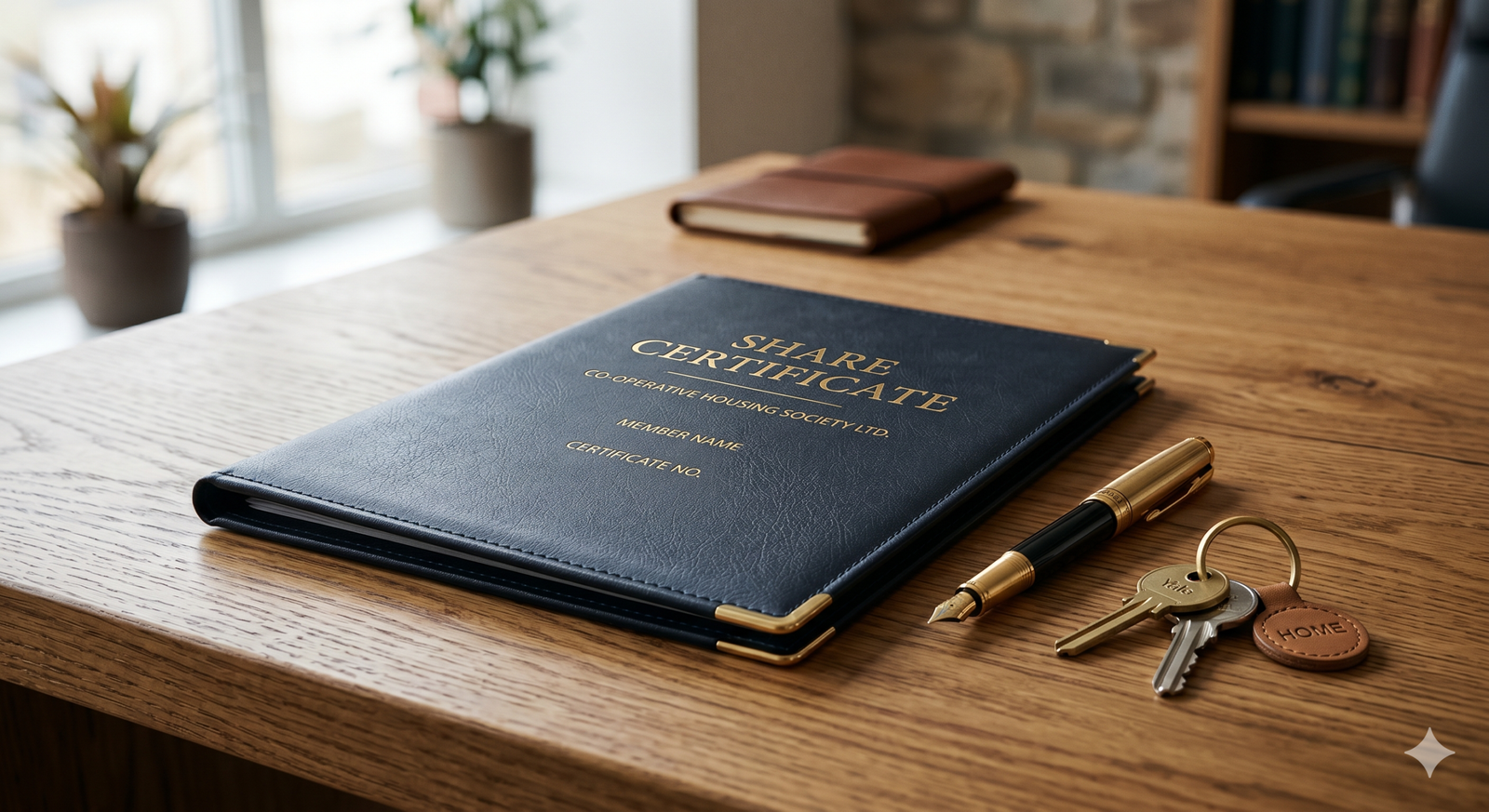
A Share Certificate is a legal document issued by a Co-operative Housing Society (CHS) to its members. It certifies that the person named therein is the registered owner of a specific number of shares in the society. Unlike a standalone bungalow owner who holds direct title to the land, a member of a housing society owns shares in the legal entity that owns the entire complex (land and building).
Its significance cannot be overstated:
- Primary Evidence of Membership: It is the conclusive legal proof that an individual is a member of the society.
- Confirming Title to Flat: While the recorded Sale Deed is essential, the Share Certificate confirms the member’s right to occupy the specific flat or unit in a cooperative structure.
- Necessary for Transfer: It is mandatory for the formal sale, transfer, or gift of the flat.
- Security for Loans: Financial institutions always require the original Share Certificate to create a mortgage or register a lien when providing a home loan.
When Should it be Issued?
Timing is a critical matter of legal compliance. According to standard Model Bye-laws (specifically referring to Bye-Law No. 9(a), as indicated in your reference images):
- Statutory Deadline: The Managing Committee must issue Share Certificates to every Member for the shares subscribed by him within a period of six months from the date of allotment of the shares.
- Takeover from Builder: Upon the formal takeover of management from a builder or developer, the process of verifying and issuing these certificates should begin immediately, aiming for full compliance within the six-month window. Delayed issuance can lead to grievances filed with the Deputy Registrar of Co-operative Societies.
Required Documents for Verification
The Managing Committee must ensure a robust verification process before signing off on any certificate. The following documents should be taken from members or verified with originals:
- Registered Sale Agreement: The primary agreement between the builder/developer and the member (or previous owner). The committee must verify that appropriate stamp duty and registration fees have been paid.
- Chain of Documents (Resale): In cases of resale flats, a complete chain of all previous registered agreements must be verified from the first owner to the current member.
- Indemnity Bond: A notarized bond collected from the member to indemnify the society against any future claims regarding the ownership of the shares or the unit.
- Membership Application (Form 2): To ensure the member has officially applied and paid the entrance fee and share capital.
Procedure for Members with Bank/NBFC Loans
A complex situation arises when a member has an active home loan from a bank or NBFC. Because the original property documents (including the main Sale Deed) are typically in the bank’s custody, the society follows this procedure:
- Verification: The member submits self-attested copies of the agreement. The society may request a letter from the bank confirming they hold the original documents.
- Lien Entry: The society records the bank’s “lien” or charge on the flat in the mandatory “I” and “J” Registers.
- Certificate Preparation: The Share Certificate is prepared in the name of the member(s) as per the registered agreement.
- Handover to Bank: Since the original certificate is required as collateral, the society usually hands the original Share Certificate directly to the authorized bank representative or NBFC and obtains a formal acknowledgment for its records.
What if a Share Certificate is Lost?
What happens if a Share Certificate is lost, destroyed, soiled, burnt, torn, or disfigured? Standard regulations (referring to Bye-Law No. 9(b) and Bye-Law No. 10, as referenced in your images) outline a clear process for issuing a duplicate.
The committee must issue a duplicate share certificate marked “DUPLICATE” or “So Marked” upon the member producing the following documents:
- Police Complaint: The member must file an FIR or a lost property report at the local police station.
- Public Notice: The member must publish a notice in two local newspapers (one in English and one in the regional language) inviting objections within 15 days.
- Indemnity Bond: The member must provide an indemnity bond on stamp paper, indemnifying the society against any loss arising from the duplicate certificate.
- Committee Approval: Once no objections are received, the Managing Committee approves the issuance of the duplicate certificate marked “DUPLICATE” in red ink.
Every duplicate share certificate must bear the seal of the society and be signed by the Chairman, the Secretary, and one Member of the Committee, duly authorized by the Committee.
Format of Share Certificate
Based on standard cooperative norms and referencing common elements (like the layout in Bye-Law Appendix-29 from your reference images), here is a standard layout for a housing society share certificate.
Conclusion
Managing the Share Certificate process is not just a clerical task; it is a fiduciary duty. Ensuring these are issued within the 6-month window and handled correctly during bank mortgages protects both the society’s legal standing and the member’s investment.
Ram Niwas Bansal
“Dedicated and highly qualified professional with a specialized focus on Cooperative Housing Society (CHS) Management and Legal Advocacy. Leveraging a strong technical background and an Indian Air Force veteran’s discipline, I provide end-to-end solutions for housing societies in Mumbai.
With a Government Diploma in Cooperation and Accountancy (GDCA) and a Diploma in Naturopathy, I bridge the gap between administrative excellence and holistic community well-being.
Frequently Asked Questions:
Q: Can a society charge for issuing the first Share Certificate?
A: Generally, no. The cost is covered by the entrance fees and share capital paid during membership application.
Q: Who signs the Share Certificate?
A: It must typically be signed by the Chairman, Secretary, and one other member of the Managing Committee, along with the society’s common seal.
Q: Is a Share Certificate mandatory for a home loan?
A: Yes, most banks will not disburse or continue a loan without a lien-marked certificate.
[SOCIETY LOGO/NAME]
(Registered under the Maharashtra Co-operative Societies Act, 1960)
Registration No. [Date]

SHARE CERTIFICATE
Member’s Regn. No. [] | Certificate No. [] | No. of Shares: [_______]

(UNDER THE BYE-LAW NO. 9)

THIS IS TO CERTIFY that Shri/Smt./M/s. [MEMBER(S) NAME] is the Registered Holder of [NO. OF SHARES] fully paid-up shares of Rs. [SHARE VALUE] each (Total Value: Rs. [TOTAL VALUE]) numbered from [SHARE NO. START] to [SHARE NO. END] (both inclusive), in the [FULL NAME OF THE HOUSING SOCIETY LTD.] subject to the Bye-laws of the said society.

GIVEN under the Common Seal of the said Society at Mira Bhayandar, Maharashtra this [_____] day of [MONTH], 2026.

(Seal of the Society)

_______________________ _______________________ _______________________

Chairman Secretary Authorized Committee Member

Date:
Is it mandatory to state Flat No. in Share Certificate? Our CHS says it’s not.
Dear Narendra,
Under the Maharashtra Co-operative Societies Act and Model Bye-laws, shares are allotted in connection with a specific property/flat, and standard Share Certificate formats include fields for details such as the flat number, building name, and share numbers to explicitly identify the member’s interest.
While older certificates sometimes omitted explicit flat details on the front face, having the flat number explicitly mentioned on the Share Certificate (or endorsed clearly) prevents ownership ambiguities—especially during property resale, mortgage, or transfer proceedings. It is highly advisable to ensure your society includes or updates the flat details on the certificate or maintains a formal allotment document linking the shares to your flat.