
Table of Contents
Introduction
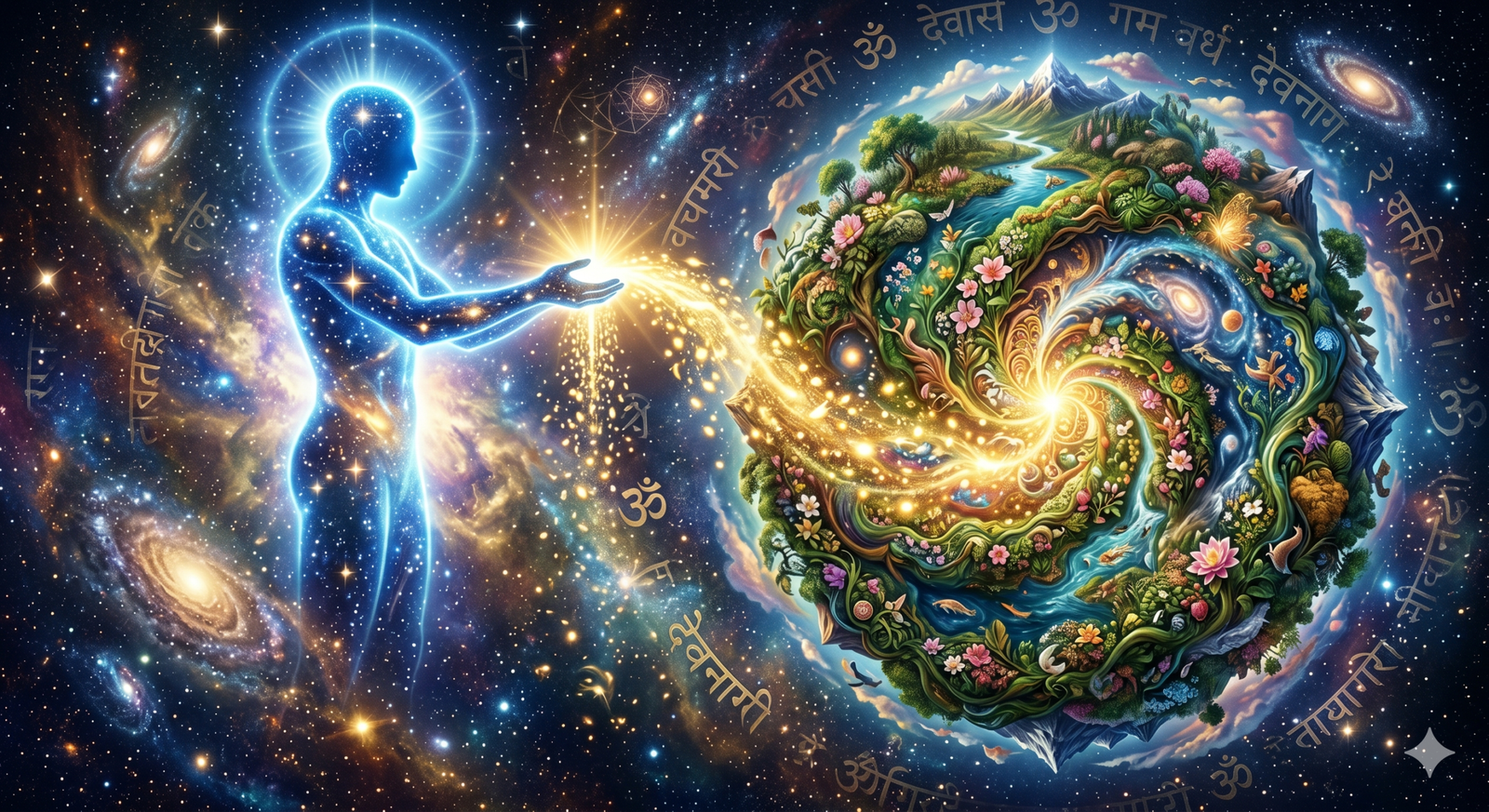
Bhagavad Gita Chapter 14 Verse 1 to 4: Just imagine—if modern science wanted to discover the ultimate blueprint of the greatest super-machine in the universe, the human body, and the entire cosmos, where would it go? To laboratories? Or to multi-billion dollar particle accelerators like CERN?
Surprisingly, the very ‘Cosmic Code’ that today’s scientists are desperately trying to decode was summarized thousands of years ago by Lord Krishna on the battlefield of Kurukshetra in just four verses!
Yes, we are talking about Bhagavad Gita Chapter 14, Verses 1 to 4.
People often think that the Gita only talks about salvation (Moksha) or renunciation (Sannyasa). However, the fourteenth chapter of the Gita (Gunatraya Vibhaga Yoga) is actually the ultimate manual of Spiritual Science that directly explains the manufacturing process of our existence. Here, Lord Krishna does not speak in a mysterious language; rather, through a crystal-clear parenting model, He explains that in this universe, ‘God’ is truly our Father and ‘Mother Nature’ is our Mother.
In this article, we will dive deep into this supreme knowledge that Sri Krishna is reminding us of—the very knowledge by which ancient sages broke all worldly bonds and attained ultimate perfection. If you want to understand life, death, and the real mechanism working behind this entire creation, this analysis will change your perspective forever.
1. The Glory of This Knowledge: Why is Sri Krishna Saying It ‘Again’?
Bhagavad Gita Chapter 14 Verse 1 to 4: Sri Krishna tells Arjuna that He is repeating that supreme knowledge once again, which He had previously hinted at in chapters like Chapter 7 and 13. A question arises here: why did the Supreme Lord need to state the same thing repeatedly?
परं भूयः प्रवक्ष्यामि ज्ञानानां ज्ञानमुत्तमम् ।
यज्ज्ञात्वा मुनयः सर्वे परां सिद्धिमितो गताः ॥ १ ॥
Meaning: Sri Krishna says, “I shall again declare to you this supreme wisdom, the best of all knowledge.” He wants to awaken Arjuna’s consciousness completely. In life, when a highly important rule or formula needs to be deeply grasped, it must be repeated. Sri Krishna clarifies that this is no ordinary worldly education; it is the highest learning, knowing which the great sages of ancient times freed themselves from worldly bondages and attained supreme perfection.
इदं ज्ञानमुपाश्रित्य मम साधर्म्यमागताः ।
सर्गेऽपि नोपजायन्ते प्रलये न व्यथन्ति च ॥ २ ॥
Meaning: This verse highlights the practical utility of this knowledge. A person who implements the core essence of Bhagavad Gita Chapter 14 Verses 1 to 4 into their life (takes shelter of it) attains ‘Sadharmya’—the divine nature of God Himself. Such liberated souls are neither reborn at the time of creation nor are they disturbed or destroyed at the time of cosmic dissolution (Maha-pralaya). They transcend the cycle of time and cosmic ages.
2. The Place of Birth: The Great Union of Matter and Spirit
Bhagavad Gita Chapter 14 Verse 1 to 4: When we look at a factory or a machine, we naturally know where the raw material came from and who designed it. From this exact scientific perspective, Sri Krishna uses a practical analogy in Verse 3 to explain the origin of creation.
मम योनिर्महद्ब्रह्म तस्मिन्गर्भं दधाम्यहम् ।
सम्भवः सर्वभूतानां ततो भवति भारत ॥ ३ ॥
Here, Sri Krishna completely demystifies the birthplace and the process of life:
- Mahad-Brahma (Total Material Nature): This is the ‘womb’ or source that we call ‘Mother Nature’ or the physical ingredients. It is insentient matter (Jada). It consists of the five great elements (earth, water, fire, air, space) along with the mind, intellect, and ego. It forms the physical infrastructure of the world.
- Garbham Dadhamy Aham (Placing the Seed of Consciousness): Sri Krishna states that He implants the seed of ‘Consciousness’ (Soul/Life) into this womb of material nature.
Understanding from a Scientific Viewpoint: Imagine a car’s entire body, engine, and filters are fully ready (Nature), but unless there is fuel and a driver (Consciousness/Soul) to operate it, that car cannot move an inch. Similarly, it is only through this grand union of insentient matter (Nature) and sentient Supreme Spirit (God) that the birth of all living and non-living entities in the cosmos becomes possible.
3. God the Father and Nature the Mother: The Universal Truth
Bhagavad Gita Chapter 14 Verse 1 to 4: In the fourth verse, Sri Krishna establishes this deep philosophical theory into a beautifully simple and familial relationship that every human being on earth can easily comprehend.
सर्वयोनिषु कौन्तेय मूर्तयः सम्भवन्ति याः ।
तासां ब्रह्म महद्योनिरहं बीजप्रदः पिता ॥ ४ ॥
Meaning: Addressing Arjuna, Sri Krishna says, “O son of Kunti! Whatever forms of embodied beings are born in all the diverse wombs (whether humans, animals, birds, insects, or plants), Great Nature is their conceiving Mother, and I am the seed-giving Father.”
This verse teaches us that every living entity in this universe is interconnected. Our physical body is made of five material elements gifted to us by Mother Nature; hence, protecting nature is our inherent duty. Concurrently, the immortal soul residing within us is an eternal fragment of the Supreme Lord Himself.
4. What is Sri Krishna Actually Trying to Teach Us in These Verses?
Bhagavad Gita Chapter 14 Verse 1 to 4: When we churn the deeper meaning of Bhagavad Gita Chapter 14 Verses 1 to 4, Sri Krishna brings forward three main realizations:
A) Eradication of Ignorance and a Clear Cosmic System
Bhagavad Gita Chapter 14 Verse 1 to 4: Human beings often assume that the world is running randomly or without any rules. Sri Krishna breaks this illusion. He shows that the cosmos operates under a meticulously planned law. The combination of matter and consciousness is the foundation of life. As long as we identify ourselves only with this ‘material body,’ we will remain trapped in miseries. The day we realize we are a conscious part of that Supreme Father, we become liberated.
B) A Sense of Equality Among All Living Beings
Bhagavad Gita Chapter 14 Verse 1 to 4: When God Himself declares that He is the seed-giving Father of all life forms, there remains absolutely no room for notions of high-and-low, caste discrimination, or cruelty towards animals. From a tiny ant to a giant elephant, and from an ordinary human to an enlightened sage—the same divine soul-element from the single Father resides within everyone. This understanding grants us the true experience of ‘Vasudhaiva Kutumbakam’ (The whole earth is my family).
C) Setting the Stage for the Cosmic Play (The Foundation for the Three Gunas)
Bhagavad Gita Chapter 14 Verse 1 to 4: These four verses form the foundation of the entire chapter. Sri Krishna is preparing Arjuna mentally: “O Arjuna, now you understand that Nature is your Mother and I am your Father. But the moment you take a physical form and step out of Nature’s womb, the three qualities of nature—Sattva (Goodness), Rajas (Passion), and Tamas (Ignorance)—bind you tightly under their control.” In the subsequent verses, Sri Krishna goes on to explain the play of these three qualities and the methods to transcend them.
Conclusion
This divine wisdom of Bhagavad Gita Chapter 14 Verses 1 to 4 connects us deeply to the roots of our existence. It reassures us that we are neither lonely nor orphaned in this vast universe; Nature is our nurturing Mother looking after us, and the Almighty God is our Father. Taking shelter of this knowledge, ancient sages achieved supreme peace. Even in today’s highly stressful modern era, realizing this truth can free us from inner mental conflicts. The moment you begin viewing yourself as a unique confluence of Nature and Spirit, your entire perspective on life changes.
Ram Niwas Bansal
“Dedicated and highly qualified professional with a specialized focus on Cooperative Housing Society (CHS) Management and Legal Advocacy. Leveraging a strong technical background and an Indian Air Force veteran’s discipline, I provide end-to-end solutions for housing societies in Mumbai.
With a Government Diploma in Cooperation and Accountancy (GDCA) and a Diploma in Naturopathy, I bridge the gap between administrative excellence and holistic community well-being.
Disclaimer
The content on this website is for educational and spiritual purposes only. Please sit down and consult with your spiritual or philosophical guide to understand these profound concepts according to your personal journey.
Frequently Asked Questions (FAQs)
Q1: What does ‘Mahad-Brahma’ mean in Bhagavad Gita Chapter 14 Verses 1 to 4?
Ans: ‘Mahad-Brahma’ refers to the primordial material nature (Mother Nature). It acts as the womb containing all physical materials (matter) necessary to build the bodies of all living entities.
Q2: Why has Sri Krishna called Himself ‘Bija-pradah Pita’ (the seed-giving father)?
Ans: Matter by itself is lifeless. Sri Krishna calls Himself the ‘seed-giving Father’ because He infuses the life-force or soul (consciousness) into lifeless matter, enabling life to manifest.
Q3: What benefit does a person get by knowing this wisdom?
Ans: By deeply understanding this knowledge, a person transcends the cycle of birth, death, joys, and sorrows. They realize they are not merely a bag of flesh and bones but a divine soul, which brings supreme peace and liberation (Siddhi).
Q4: Is this knowledge useful in practical daily life?
Ans: Yes, absolutely. It teaches us that a spark of the same Divine exists in all living beings. This fosters compassion, equality, and emotional balance within us, which is incredibly crucial for navigating today’s stressful life.