
Table of Contents
Introduction
Bhagavad Gita Chapter 2, Verse 14: In our fast-paced modern lives, we are constantly bombarded by highs and lows. One moment we are celebrating a success, and the next, we are grappling with a setback. This “emotional rollercoaster” can be exhausting.
However, ancient wisdom offers a profound solution to this modern struggle. Today, let’s dive into a pivotal verse from the Bhagavad Gita: Chapter 2, Verse 14, where Lord Krishna provides Arjuna (and all of us) a masterclass in emotional resilience.
The Verse: Bhagavad Gita Chapter 2, Verse 14
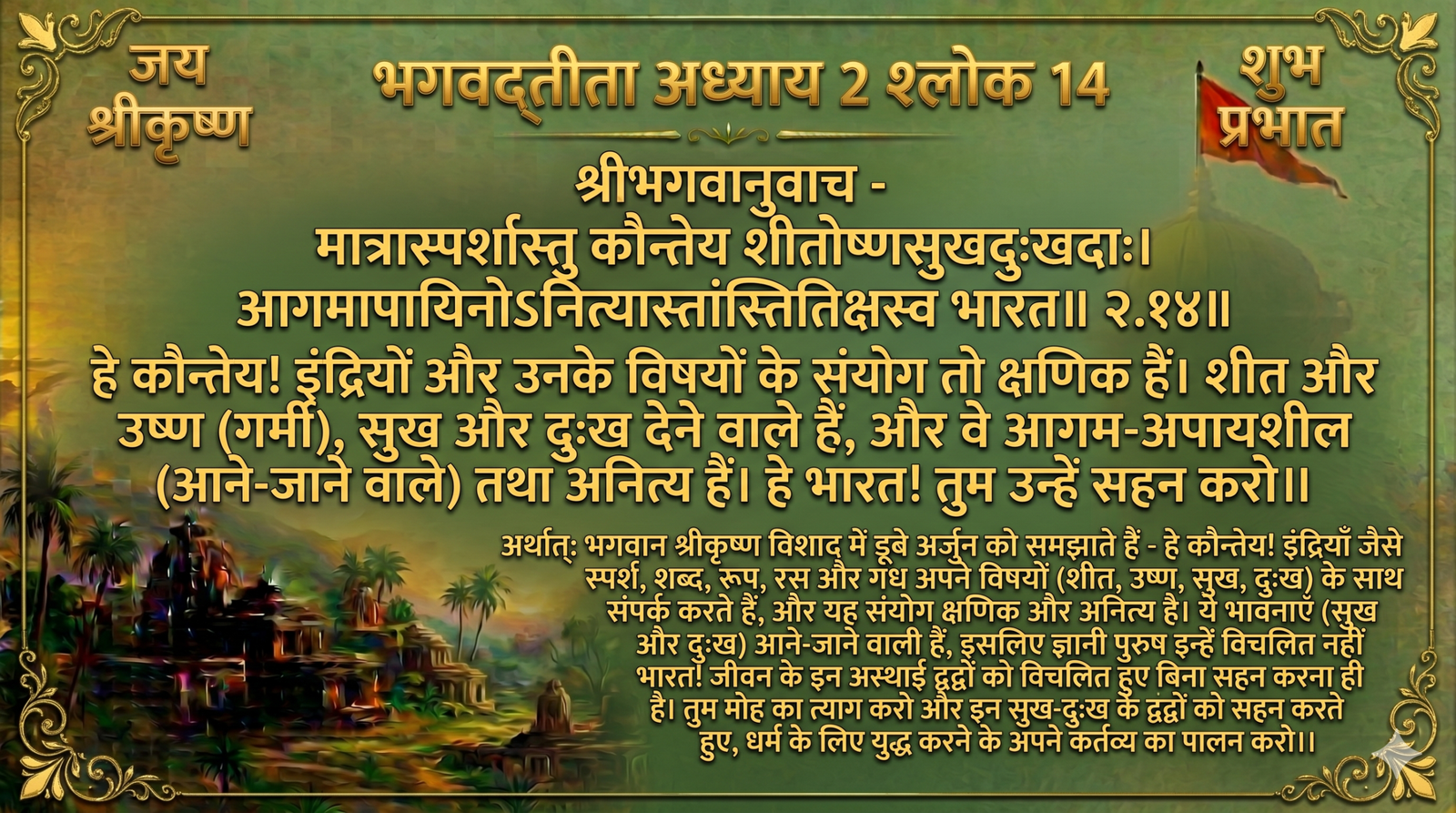
मात्रास्पर्शास्तु कौन्तेय शीतोष्णसुखदुःखदाः।
आगमापायिनोऽनित्यास्तांस्तितिक्षस्व भारत॥ २.१४॥
Translation:
“O son of Kunti, the contact between the senses and their objects gives rise to fleeting perceptions of happiness and distress. These are non-permanent, appearing and disappearing like the winter and summer seasons. O scion of Bharata, one must learn to tolerate them without being disturbed.”
The Anatomy of Experience
Krishna explains that our feelings of pleasure and pain are simply the result of our senses coming into contact with external objects. Just as skin feels the cold of winter or the heat of summer, our mind registers “happiness” or “sadness” based on external circumstances.
In modern psychology, we often talk about ‘Cognitive Reframing.’ Lord Krishna introduced this concept thousands of years ago. When the verse mentions mātrā-sparśāḥ (sensory contact), it refers to the physiological electrical impulses our brain receives. Our suffering doesn’t come from the cold weather or a tough boss; it comes from our interpretation of that contact. By realizing that these signals are temporary data points, we can reduce our stress response. This is why Bhagavad Gita Chapter 2 Verse 14 is not just a religious teaching, but a practical manual for mental health.
Key Takeaways for Daily Life:
1. The Seasonality of Life
Krishna uses the analogy of seasons. Winter doesn’t stay forever, and neither does summer. Similarly, a period of grief or a phase of extreme joy is “āgamāpāyinaḥ”—meaning they have a beginning and an end. Recognizing this impermanence prevents us from becoming too arrogant during good times or too despondent during bad ones.
2. The Power of ‘Titiksha’ (Tolerance)
The word Titikṣasva is crucial. It doesn’t mean “suffering in silence” with a heavy heart. It means spiritual endurance. It is the ability to observe a feeling, acknowledge its presence, but refuse to let it dictate your actions or your inner peace.
3. Strengthening the Mind
By practicing this detachment, we develop a “steady intellect.” We start to realize that while we cannot always control the “weather” (external events), we can certainly control our “internal climate.”
Whether managing a complex real estate project, a healthcare facility, or a housing society, the ability to remain ‘Sthitaprajna’ (equanimous) is what separates a leader from a follower. If a leader panics during a temporary “winter” of crisis, the entire team loses morale. Bhagavad Gita Chapter 2 Verse 14 teaches us that professional setbacks and market fluctuations are inherent to the system. By practicing Titiksha, we save our mental energy from being wasted on complaining and instead redirect it toward problem-solving. This ancient wisdom is the ultimate tool for corporate resilience and effective decision-making.
Moving Toward Balance
This verse stands out as a practical tool for anyone in the corporate world, healthcare, or community management. When a crisis hits, or when things don’t go as planned, reminding yourself—“This is a passing season”—changes your entire perspective.
Stability isn’t the absence of change; it is the presence of a calm mind amidst change.
Reflect with me:
What “season” are you currently navigating in your life? How would your day change if you viewed your current challenge as a passing weather pattern?
Ram Niwas Bansal
“Building trust through discipline. As an IAF Veteran and certified Mutual Fund Distributor & Insurance Advisor, I help you secure your family’s future while you manage your property today.”
Disclaimer
Disclaimer: The interpretations provided here are based on intensive research of ancient scriptures and are intended for spiritual and educational purposes only. While we explore the connections between spirituality and holistic health, this content is not a substitute for professional medical advice, diagnosis, or treatment. Always seek the advice of your physician or qualified health provider regarding any medical condition.