
Table of Contents
Introduction
Recovery procedure u/s 154B (29) of MCS Act 1960 is the primary legal tool available to Cooperative Housing Societies (CHS) in Maharashtra to address the challenge of non-paying members. Unlike lengthy civil litigations, this specific provision under the 2019 Amendment offers a streamlined path to ensure the financial health of the society is not compromised by a few individuals.
Definition of Defaulter
Before initiating the recovery procedure u/s 154B (29) of MCS Act 1960, the society must establish that a member is legally a “defaulter.” A member is classified as a defaulter if they fail to pay the maintenance charges or other society dues for a period exceeding three months.
As a cooperative entity, every member has a collective responsibility to contribute to the upkeep of the premises. When a member defaults, it creates a deficit that impacts every other resident.
The “Three-Notice” Best Practice
While the law requires a formal warning, following a structured “Three-Notice” protocol ensures that your recovery procedure u/s 154B (29) of MCS Act 1960 stands up to legal scrutiny by fulfilling the principles of “Natural Justice”:
- First Reminder: Issued as soon as the 3-month default period is crossed.
- Second Reminder: Sent 15 days later, emphasizing the mounting interest and the society’s financial requirements.
- Final Statutory Notice: Sent 15 days after the second notice. This notice must grant a final opportunity for payment within a stipulated period. Crucially, it must include a clear warning that failure to pay will result in an application to the Registrar for recovery.
Step-by-Step Procedure for Recovery
Recovery procedure u/s 154B (29) of MCS Act 1960: Once the final notice period expires without payment, the society must follow this formal sequence:
- Managing Committee Resolution: The committee must pass a formal resolution to initiate the recovery procedure u/s 154B (29) of MCS Act 1960.
- Authorization: The resolution must authorize the Chairman or Hon. Secretary to sign all documents and furnish information to the Registrar.
- Application Submission: The authorized officer applies to the Registrar along with the required supporting evidence.
- Registrar’s Hearing: The Registrar will hear the defaulter member and verify the society’s records.
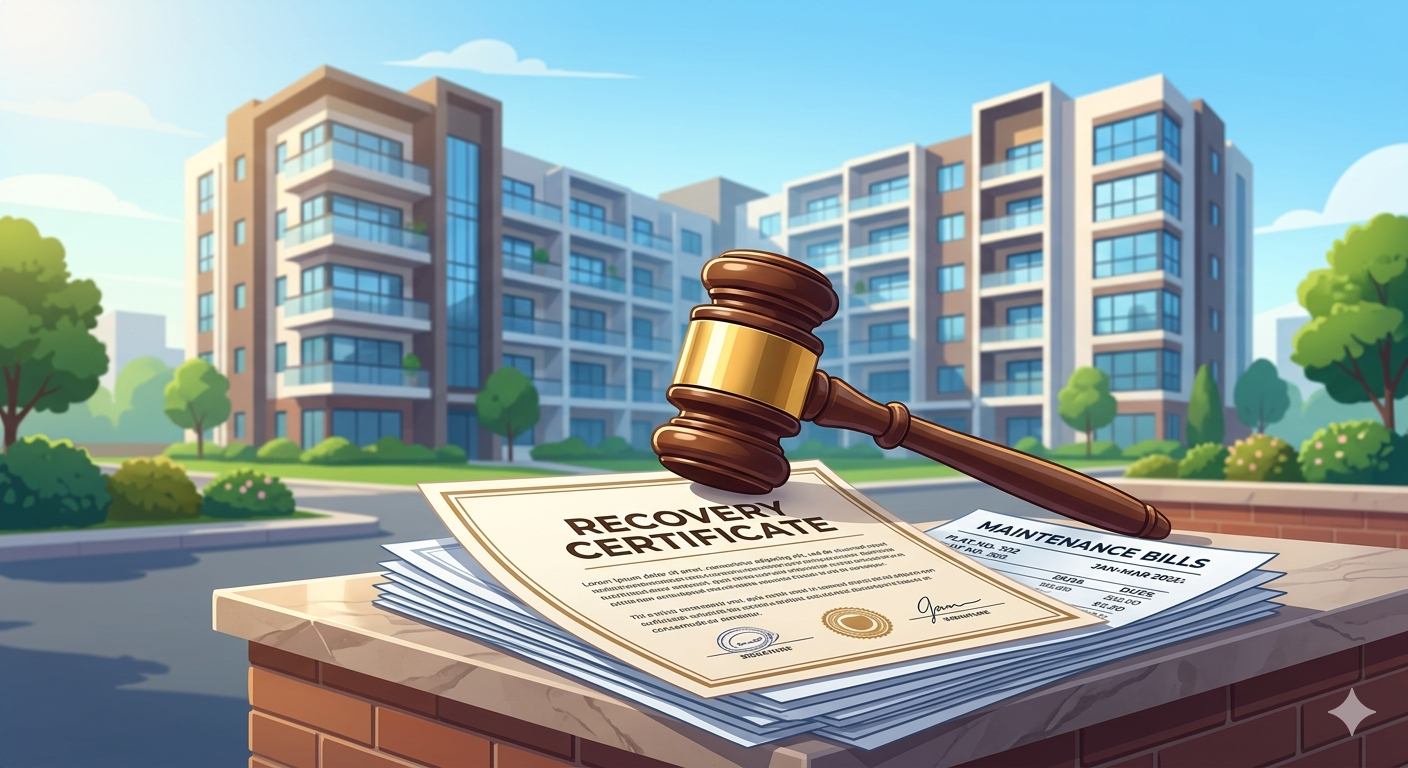
- Issuance of Certificate: If satisfied with the correctness of the dues, the Registrar issues a Recovery Certificate.
- Execution and Auction: The Recovery Officer prepares a demand notice to seize and auction movable property. If those proceeds are insufficient, the Sale Officer may proceed against the flat itself.
Required Documentation Checklist
When the Hon. Secretary or Chairman makes the application to the Registrar, it must be accompanied by specific supporting documents to verify the claim. Before proceeding for Recovery procedure u/s 154B (29) of MCS Act 1960 ,Ensure you have the following copies ready:
- Two copies of the formal application: One of these copies is typically sent to the opponent (the defaulter) by the Registrar.
- Resolution on Charges: A copy of the General Body or Managing Committee resolution that originally decided the proportion of charges for each member (including service charges and other heads).
- Authorization Resolution: A copy of the resolution passed by the Managing Committee authorizing the Secretary to take legal recovery action.
- Note: While your template mentions Section 101, ensure your current resolution specifically cites Section 154B-29 for housing society matters.
- Ledger Account Extract: A detailed extract of the member’s Ledger Account showing the specific charges due and the history of non-payment.
- Proof of Service: A copy of the acknowledgement receipt showing that the member received the formal notice.
- Additional Evidence: Any other documents that support the society’s claim of outstanding dues.
⚠️ Important Update: The Verification Affidavit Nuance
While reviewing the checklist for a Section 154B(29) recovery application, a vital point regarding the Verification Affidavit deserves special attention:
- What the law says: Under Section 154B(29) of the MCS Act, 1960, the application must be submitted in the prescribed Form O. The format itself requires the authorized office bearers to sign and verify the contents of the application.
- The Practical Reality: Even though the bare text of the law focuses on the verification within Form O, the office of the Assistant/Deputy Registrar (AR/DR) frequently raises technical objections if a separate, stamped Verification Affidavit is missing.
💡 Pro-Tip for Management Committees: Do not leave room for administrative delays. Always attach a separate Verification Affidavit on a ₹100/- stamp paper (duly notarized). In this affidavit, the Chairman and Secretary solemnly affirm that the statement of outstanding dues, interest calculations, and member details provided in the application are true and correct to the best of their knowledge.
Including this affidavit along with your Managing Committee Resolution and the 3-tier notice history ensures your case passes the initial scrutiny phase without getting stuck on technical grounds.
Conclusion: Balancing Legal Action with Cooperative Harmony
The recovery procedure u/s 154B (29) of MCS Act 1960 is more than just a legal mechanism; it is a vital safeguard for the financial stability of your housing society. While the goal of any managing committee is to maintain a harmonious living environment, ensuring that every member contributes their fair share is essential for the collective well-being of the community.
By following a transparent “Three-Notice” process and maintaining meticulous documentation, a society can resolve even the most stubborn default cases with professional ease. Remember, the strength of a cooperative housing society lies in the mutual cooperation of its members. Implementing a firm yet fair recovery procedure ensures that your society remains well-maintained, financially secure, and a pleasant place for all residents to call home.
Is your committee facing challenges with maintenance recovery? Download our Recovery Procedure Toolkit below to get started with the right templates and checklists today.
Ram Niwas Bansal
“Dedicated and highly qualified professional with a specialized focus on Cooperative Housing Society (CHS) Management and Legal Advocacy. Leveraging a strong technical background and an Indian Air Force veteran’s discipline, I provide end-to-end solutions for housing societies in Mumbai.
With a Government Diploma in Cooperation and Accountancy (GDCA) and a Diploma in Naturopathy, I bridge the gap between administrative excellence and holistic community well-being.
Frequently Asked Questions (FAQs)
Q1: Is it mandatory to go to the Cooperative Court first?
No. The recovery procedure u/s 154B (29) of MCS Act 1960 is a summary procedure that allows societies to go directly to the Registrar, bypassing the lengthy court process.
Q2: Can the society seize the flat immediately?
The Sale Officer first attempts to recover dues by auctioning movable property. Only if those proceeds are insufficient does the officer proceed against the flat.
Q3: What if the member disputes the amount?
The Registrar will conduct a hearing specifically to verify the correctness of the outstanding dues before issuing any certificate.
Disclaimer
This post is for educational purposes and is based on the Maharashtra Co-operative Societies Act, 1960. While the information is intended to be accurate, managing committees should consult with a legal expert or the District Housing Federation for specific case-by-case guidance.
Pingback: Recovery of Old Maintenance Dues: 1 HC Landmark Verdict
The applicant society has not attached Verification Affidavit in 154B (29) Recovery case alongwith other documents
The said verification is also not mentioned in your list of documents
Is it mandatory for the Society to submit the verification affidavit?
“Thank you for pointing this out. Under Section 154B(29) of the MCS Act, 1960 (read with Rule 107D of the MCS Rules), the recovery application must be submitted in the prescribed Form O.
While a detailed supporting affidavit is common practice to strengthen the case and verify the facts stated in the application, the statutory requirement explicitly mandates the submission of Form O duly signed and verified by the authorized office bearers, backed by a true copy of the managing committee’s resolution, the statement of accounts, and the 3-tier notice history.
However, ensuring a separate Verification Affidavit is attached is highly recommended to prevent the Assistant Registrar (AR) from raising technical objections during scrutiny. I will update the checklist in the article/video description to reflect this best practice. Thanks for helping make the content more accurate!”