
Table of Contents
Introduction
Diabetes lifestyle management has become one of the most critical health discussions of our time, yet many people still misunderstand how this metabolic disorder truly functions. To understand it, think about what happens when a household lightbulb or electrical appliance suddenly stops working. Out of sheer frustration, a person’s immediate reaction is to aggressively flip the wall switch on and off four or five times. The switch isn’t actually the problem, but because it is the most visible, immediate point of contact, it bears the absolute brunt of our irritation.
In a very similar way, when our internal body systems face a metabolic crisis, we often focus all our attention on the immediate symptom—the elevated blood sugar reading—while ignoring the underlying habits that are causing the breakdown. Type 2 Diabetes is not a sudden, acute disease; it is a chronic metabolic condition that stems directly from our daily environment, lifestyle choices, and physiological habits.
1. The Shifting Paradigm: How Modern Living Compromised Our Health
Diabetes lifestyle management: Over the last 25 to 30 years, a dramatic shift has occurred in global health trends. A generation ago, the general population was significantly healthier, and the average lifespan was characterized by far fewer chronic metabolic ailments. Decades ago, common illnesses were primarily short-term, acute infections or environmental bugs, such as:
- Fevers, coughs, and colds
- Cholera and chickenpox
Today, despite massive advancements in medical science, a proliferation of advanced treatments, and an exponential increase in multi-specialty hospital facilities, our average healthy lifespan has sharply declined. The modern population faces an undeclared epidemic of chronic lifestyle diseases, including:
- Diabetes and Obesity
- Hypertension and Elevated Cholesterol
- Thyroid malfunctions and Piles
- Heart diseases, along with debilitating joint and muscular pain
According to the International Diabetes Federation (IDF), in 2024, approximately 589 million adults (ages 20–79) were living with diabetes worldwide—a staggering figure that is projected to climb to 853 million by 2050. India currently ranks as the number two hotspot globally. Alarmingly, 75% of these diabetic individuals reside in low- and middle-income countries, 252 million adults remain entirely undiagnosed, and more than 1.2 million children and adolescents are fighting Type-1 diabetes. Furthermore, 1 in 6 live births globally are impacted by diabetes during pregnancy, and 541 million adults stand at a highly elevated risk of developing Type-2 diabetes.
The primary catalyst for this shift is a profound change in our living conditions: sedentary lifestyles, irregular sleeping patterns, junk food consumption, physical inactivity, chronic physical or mental stress, emotional factors, and smoking or alcohol usage.
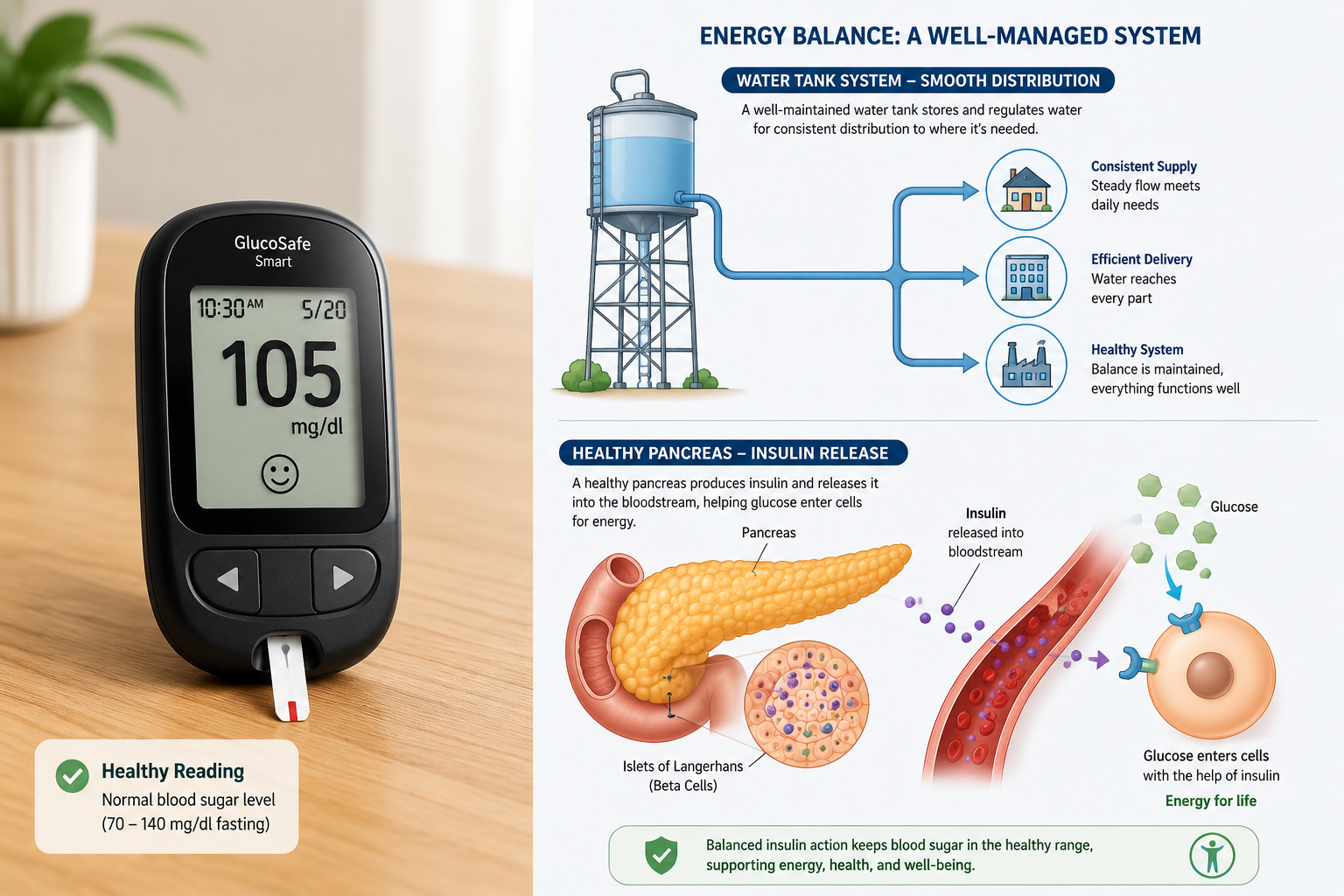
2. The Physiology of Blood Glucose: The “Water Tank” Analogy
Diabetes lifestyle management: To understand how diabetes develops, we must examine the normal composition of human blood. Blood contains plasma, red blood cells, white blood cells, platelets, and vital nutrients like proteins, lipids, vitamins, minerals, and glucose. Every single constituent operates within strict, pre-defined homeostatic boundaries.
When you consume a nutrient-dense meal, your digestive system delivers a bulk supply of carbohydrates, proteins, and lipids into the bloodstream. In a normal state after eating, blood glucose must not exceed 140 mg/dl. Because the bloodstream cannot safely hold this sudden surge of sugar, the excess glucose must be parked somewhere immediately.
Think of this like a municipal water supply that only runs for a limited time each day. To ensure you have water throughout the afternoon, you store the bulk supply in a storage tank and draw from it as needed. Our bodies use a nearly identical storage mechanism:
[ Nutrient Meal Consumed ]
│
▼
[ Bulk Glucose Enters Blood ] ──(Must keep under 140 mg/dl)──► [ Insulin Secreted by Pancreas ]
│
▼
[ Excess Glucose Pushed Into ]
├─ Muscles (Energy/Glycogen)
└─ Adipose Tissues (Fat Storage)
Muscles and adipose (fat) tissues are the only storage tanks where excess glucose can be safely parked. However, these tissues are strictly insulin-dependent. Within 3 minutes of eating, a healthy pancreas secretes insulin from its beta cells. Insulin acts as a key to unlock the mechanism inside these tissues, allowing excess glucose to be pushed inside the cells so the body can use these nutrients as and when required.
Apart from muscles and fat cells, no other tissues require insulin to absorb glucose. Because other vital organs take up sugar freely without a protective barrier, you do not experience severe symptoms immediately when the insulin pathways fail, transforming diabetes into a dangerous silent killer.
3. The Insulin-Glucagon Balance vs. Constant Grazing
Diabetes lifestyle management: Physiologically, Type-2 Diabetes occurs due to two main malfunctions: either the pancreas fails to secrete a sufficient quantity of insulin, or the body’s cells become resistant to the action of insulin.
When working correctly, the body follows a precise metabolic sequence to handle glucose:
- Energy Fulfillment: Glucose is first used directly to meet the immediate energy requirements of the body.
- Glycogen Storage: Excess glucose is converted into glycogen and packed into the liver and muscles.
- Fat Conversion: If any remaining excess sugar is left over, it is converted into fat/triglycerides and stored in adipose tissues.
Approximately 3 to 4 hours after a meal, as blood sugar drops and you begin to feel hungry, the pancreas releases a counter-hormone called glucagon, which performs the exact reverse function of insulin. Glucagon signals the liver to convert stored glycogen back into glucose, followed by muscle glycogen reserves, to keep your energy steady. In the final stage, when glycogen is depleted, it converts stored fat into fatty acids or ketones for energy.
However, modern grazing habits completely disrupt this beautiful natural cycle. When you eat continuously every 2 to 3 hours, you cause two severe metabolic failures:
- You place an unending, exhausting workload on the pancreas to continuously release insulin.
- You completely block glucagon from doing its job, making it impossible for the body to ever access or burn through its stored glycogen and fat reserves.
4. Recognizing the Manifestations and Long-Term Complications
Diabetes lifestyle management: When the metabolic machinery breaks down and blood glucose levels cross 125 mg/dl in a fasting state or 200 mg/dl in a postprandial (fed) state, a clinical diagnosis of Diabetes Mellitus is confirmed. This structural failure manifests through four classic symptoms:
Glycosuria: When the renal threshold is crossed, the filtering kidneys can no longer reabsorb the excess glucose, causing sugar to spill directly into the urine.
Polyuria: Glucose in the bloodstream exerts an osmotic pull, withdrawing large quantities of water out of body tissues, causing frequent urination.
Polydipsia: The massive loss of water via urination triggers cellular dehydration, leading to a frequent, unquenchable thirst.
Polyphagia: Because insulin resistance or a lack of insulin blocks muscle fibers from absorbing nutrients, cells starve. This induces persistent weakness and frequent hunger, driving individuals to eat more and more, which accelerates obesity.
THE DIABETES COMPLICATION TRAP
| Macrovascular Angiopathy | Microvascular Angiopathy |
|---|---|
| High glucose reduces blood fluidity, making it sticky and viscous. | Clotting occurs inside micro- capillaries and tiny vessels. |
| Other nutrients adhere to vessel walls. | Deprives cells of oxygen. |
| Forms dangerous clots in large vessels. | Causes Retinopathy (Cataract, Glaucoma, and Blindness). |
| Damages the Heart, Brain, and Kidneys. | Neuropathy (Limb Tingling and loss of motor control). |
| Nephropathy (Renal Malfunction) |
Diabetes lifestyle management: When conventional medications are used to forcefully depress blood sugar levels, they often act by blocking various cellular receptors. This can hamper the body’s natural absorption of essential nutrients and place a heavy operational workload on the liver and kidneys to flush out chemical medicinal waste. While pharmaceutical management may delay the immediate onset of macrovascular and microvascular complications, relying on them alone without correcting daily habits means long-term systemic damage remains certain.
5, Management Through Systematic Lifestyle Modifications
Diabetes lifestyle management: To break free from this metabolic trap, we must address the root environmental causes through systematic lifestyle modifications rooted in Naturopathy:
- Circadian Rhythm Alignment: Maintain an “early to bed, early to rise” sleep schedule. Secure 7 to 8 hours of uninterrupted, sound sleep, protecting the critical metabolic recovery window between 10:00 PM and 2:00 AM.
- Morning Hydration: Drink a minimum of 500 ml of warm water immediately upon waking to flush out cellular metabolic waste.
- The Abdominal Posture Rule: Sit in Malasan (the deep squatting posture characteristic of traditional Indian-style toilets) for 3 to 5 minutes before going to the toilet to optimize abdominal elimination.
- Alkaline Vegetable Juices: Consume freshly extracted white ash gourd juice, pure coconut water, or raw green vegetable juice around 8:00 AM. Fast completely for at least one hour afterward to maximize tissue detoxification.
- Living Nutritional Enzymes: For breakfast, consume 700 to 800 grams of whole, fiber-rich fresh fruits (strictly avoid strained juices) along with a handful of raw sprouts. Eat nothing else until lunch.
- Pre-Meal Fiber Barrier: Eat 400 grams of fresh raw salad immediately before your lunch to slow down glucose absorption, and conclude the meal with a glass of freshly prepared buttermilk.
- Evening Nutrition: Limit evening snacks exclusively to whole fruits, dry fruits, or fresh juice. Consume zero complex carbohydrates, heavy proteins, or fats during this time.
- Simple Dinner: Keep dinner exceptionally light and easily digestible, such as a basic flatbread (roti) with vegetables, or simple dal and rice.
- Dietary Eliminations: Strictly eliminate tea, coffee, animal milk, and all processed dairy products from your daily routine.
- Physical Activity Amplification: Walk or exercise for 30 to 40 minutes daily, which replicates the physiological mechanics of insulin by drawing glucose directly into muscles. Walk for any errand within 500 meters, use the stairs for at least the first 3 floors before taking an elevator, manually wash at least one piece of clothing daily, and place a cool, wet handkerchief across your forehead, eyes, and face for 10 minutes to soothe the nervous system.
6. Restoring Pancreatic Vitality with Directed Yoga Asanas
Diabetes lifestyle management: Regular practice of specific Yoga asanas exerts direct physical compression on the abdominal organs, stimulating the Islets of Langerhans within the pancreas while simultaneously lowering systemic blood pressure and mitigating mental stress.
Bhujangasana (Cobra Pose)
- Benefits: Highly effective for opening up the chest, stimulating abdominal organs, and alleviating chronic back pain.
- Execution: Lie flat on your stomach with your feet together and forehead touching the floor. Place your palms flat beside your chest with elbows pointing upward. Inhaling deeply, slowly lift your upper body—raising the head first, then arching the chest off the floor while looking upward. Hold the position firmly for 5 to 6 seconds. Exhale slowly while lowering your chest and head back to the ground. Perform 3 complete repetitions.
Setu Bandhasana (Bridge Pose)
- Benefits: Strengthens the thighs and core abdominal muscles, massages internal digestive organs, reduces systemic anxiety, and improves blood circulation.
- Execution: Lie flat on your back with your arms resting at your sides, knees bent, and feet placed flat on the floor at hip-width. Slowly lift your lower back off the ground, followed gradually by your middle back. Distribute your body weight evenly across your shoulders, arms, and parallel legs. Hold this elevated bridge position steadily for 30 seconds up to a full minute, then gently lower down. Repeat 3 times.
Vajrasana (Thunderbolt Pose)
- Benefits: A powerful meditative posture that alters pelvic blood flow. Notably, this is the only yogic posture that can be safely performed immediately after eating to assist digestion.
- Execution: Kneel on the floor with an erect spine, keeping your big toes touching and heels spread apart. Lower your hips until your buttocks rest comfortably in the hollow space between your feet. Place your palms flat on your thighs just approx. above the knees, close your eyes, and breathe deeply. Maintain this posture for an initial 5 minutes, gradually extending the duration.
Dhanurasana (Bow Pose)
- Benefits: Provides deep, therapeutic intra-abdominal pressure that tones the pancreas, reduces emotional stress, and opens the chest and shoulders.
- Execution: Lie prone on your stomach. Bend your knees backward toward your hips, reach back, and firmly grasp your ankles. Inhaling steadily, pull your ankles to lift your thighs and chest simultaneously off the floor, balancing your weight on your abdomen. Hold the fully extended pose comfortably without straining, then release. Perform 3 repetitions.
Mandukasana (Frog Pose)
- Benefits: Delivers direct, focused compression to the pancreatic region, making it an essential practice for managing blood sugar levels across all age groups.
- Execution: Sit fully in Vajrasana. Form tight fists with your hands, place them directly over your navel, and press your abdominal wall inward. Exhale completely while bending your upper body forward, keeping your neck extended and gaze fixed straight ahead. Suspend your breath and hold the forward position for several seconds. Inhale slowly as you return to the upright kneeling position. Complete 3 full repetitions.
Conclusion
Diabetes lifestyle management: Managing metabolic wellness requires shifting our focus away from simply supressing numbers with medication and redirecting our energy toward comprehensive diabetes lifestyle management. Just as clicking a faulty light switch repeatedly won’t fix a deeper electrical issue, forcing blood sugar down with pills without altering your environment ignores the underlying physiological strain on your organs. By adopting structured circadian sleep schedules, natural alkaline nutrition, and targeted yogic practices, you relieve the chronic burden on your pancreas and restore natural balance to your body.
FAQ (Frequently Asked Questions)
Q1. Can lifestyle modifications truly manage Type-2 Diabetes without heavy reliance on medication?
Ans: Yes. Strategic lifestyle changes—such as practicing daily physical exercises like walking, avoiding constant grazing to allow glucagon activation, and adopting a fiber-rich raw diet—can effectively enhance insulin function and return blood glucose levels to normal ranges.
Q2. Why does physical inactivity or an irregular sleep cycle affect my blood sugar measurements?
Ans: A sedentary lifestyle directly triggers insulin resistance, while poor sleep patterns disrupt the body’s primary metabolic recovery window (10 PM to 2 AM), causing hormonal imbalances that elevate blood glucose levels.
Q3. Which Yoga asana is considered unique for its immediate digestive benefits after meals?
Ans: Vajrasana (Thunderbolt Pose) is highly unique because it is the only asana that can be performed directly after eating. It alters blood flow patterns to optimize digestion and calm the nervous system.
Disclaimer
Diabetes lifestyle management: This content is provided for informational and educational purposes only and is based on traditional lifestyle and naturopathic principles. It does not constitute professional medical advice, diagnosis, or treatment. In case of a medical emergency, always consult a qualified medical doctor. Do not alter, reduce, or stop any prescribed diabetes medications without explicit guidance and supervision from your primary physician.
Pingback: Fasting Therapy for Diabetes: 3 Ways It Reverses T 2 Element