Table of Contents
Introduction
Housing Society Law, Bombay High Court 2026: A significant legal development has emerged from the Bombay High Court that every Managing Committee member and flat owner in Maharashtra must understand. In a recent judgment (April 2026) involving the Malad Cooperative Housing Society Ltd, the court has drawn a firm line regarding the powers of a society when it comes to flat membership and title disputes.
For years, many Cooperative Housing Societies (CHS) have acted as gatekeepers, often refusing to transfer shares or grant membership if there is a hint of a family dispute or a missing link in the chain of documents. This ruling effectively puts an end to that practice.
The Case Brief: Malad CHS vs. The Registrar
The dispute arose within a family, where internal disagreements regarding the succession and ownership of a flat led the society to stall a membership application. The society argued that since the “title” or legal ownership was not clear among the various heirs, they could not admit a new member.
However, in the Housing Society Law High Court Order 2026, presided over by Justice Amit Borkar, dismissed this logic. The court clarified that proceedings under Section 23 of the Maharashtra Cooperative Societies (MCS) Act are “summary in nature.” A society’s role is to ensure the smooth administration of the building—not to act as a judge in complex civil disputes.
Why Membership is NOT Ownership
The most crucial takeaway from this ruling is the legal distinction between being a “Member” of a society and being the “Owner” of a property. The court noted that granting membership to a person does not automatically make them the sole owner to the exclusion of other legal heirs.

Housing Society Law, Bombay High Court 2026, Membership is for administrative convenience. It allows a person to represent the flat in society affairs, pay maintenance, and vote. If other heirs believe they have a right to the property, the correct forum for them is a Civil Court, not the society’s office. The society cannot use a pending family feud as a reason to keep a membership vacant or “on hold” indefinitely.
The Practical Question: Who Gets the Membership?
When multiple heirs approach the society, the committee often finds itself in a dilemma. Based on the MCS Act and the Model Bye-laws, here is the protocol to follow in light of this ruling:
1. The Joint Membership Route
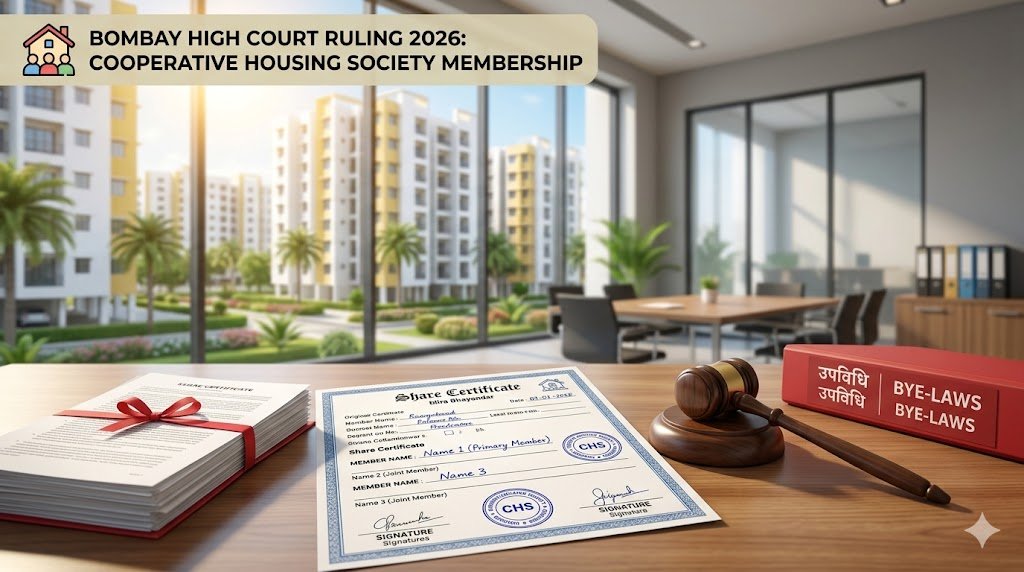
Under Bye-law No. 34, if there are multiple heirs, they should ideally apply jointly. The first name on the form becomes the Primary Member, and the others become Associate/Joint Members. This is the cleanest way to ensure all interests are recorded on the Share Certificate without the society taking sides.
2. Use of Indemnity Bonds (Appendix 19)
If one heir is pushing for membership and others are silent or objecting without a court order, the society must protect itself. The society is entitled to demand an Indemnity Bond. This legal document ensures that if the society faces any litigation or loss due to this transfer, the applicant will be personally liable to compensate the society.
3. The “Prima Facie” Evidence
If heirs cannot agree, the committee must look at who has the strongest “prima facie” (at first sight) case. Is there a registered Will? Is the person currently residing in the flat? Are they paying the society dues? Per the High Court, the society should proceed with the most eligible applicant rather than stalling. The court stated that societies shouldn’t be “over-technical” in these matters.
Final Thoughts for Managing Committees
Managing a housing society is an administrative task, not a judicial one. By trying to “be fair” and waiting for family disputes to resolve, committees often inadvertently violate the MCS Act.
This Housing Society Law, Bombay High Court 2026 ruling is a reminder that the society must follow the directions of the Registrar. If an applicant meets the basic criteria of the bye-laws, the membership should be processed. For flat owners, this brings a sense of relief. It ensures that your administrative rights—like getting a parking space or attending AGMs—are not held hostage by internal family politics.
Ram Niwas Bansal
“Dedicated and highly qualified professional with a specialized focus on Cooperative Housing Society (CHS) Management. Leveraging a strong technical background and an Indian Air Force veteran’s discipline, I provide end-to-end solutions for housing societies in Mumbai.
With a Government Diploma in Cooperation and Accountancy (GDCA 2024) and a Diploma in Naturopathy, I bridge the gap between administrative excellence and holistic community well-being.
Disclaimer
This post is for informational purposes only. For specific legal cases, always consult with a qualified legal professional specializing in Cooperative Housing Society laws.
Pingback: Guide 2 CHS Bank Account Transfer from Chief Promoter