
Table of Contents
Introduction (Inactive Committee Members):
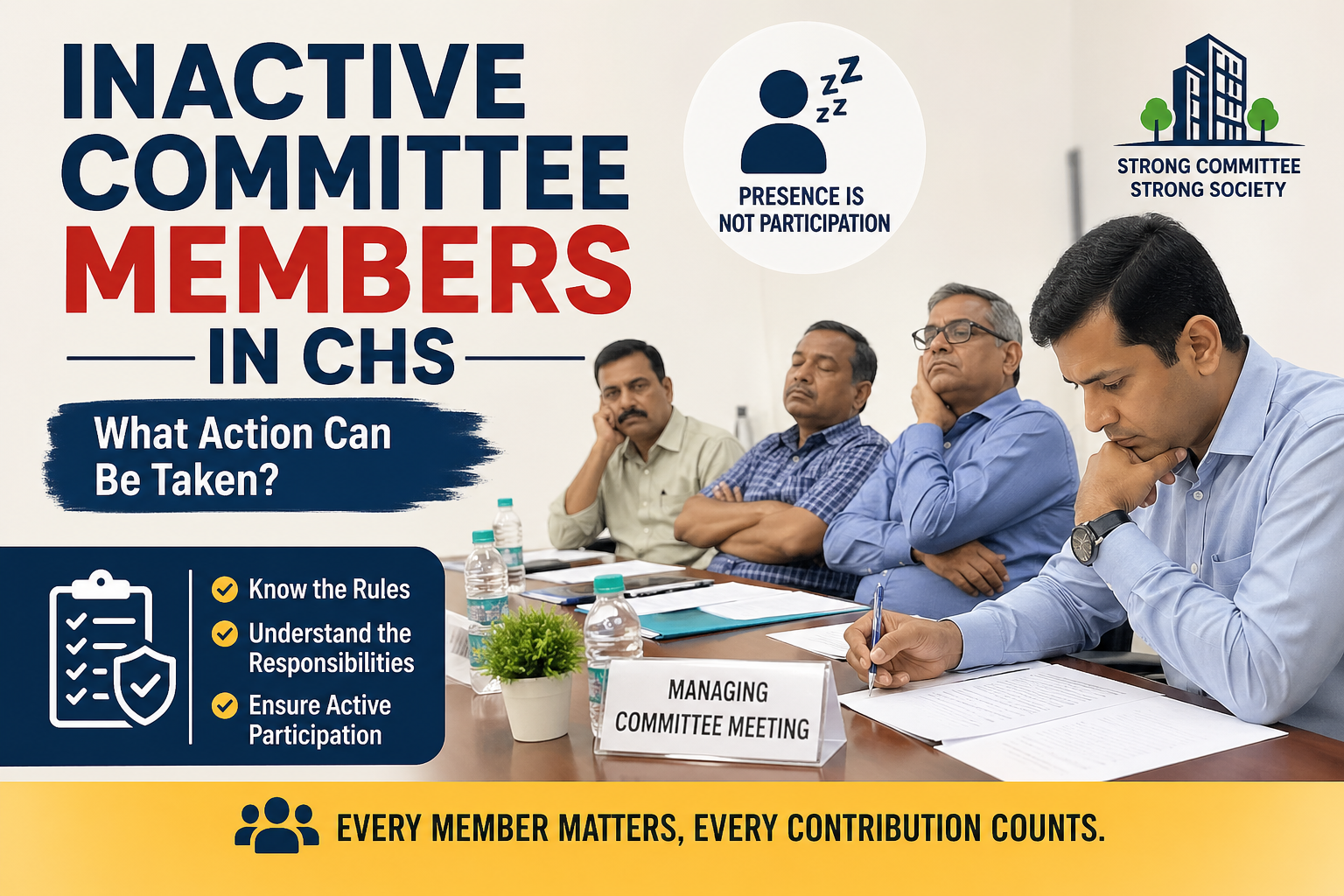
In many Cooperative Housing Societies (CHS), members get elected to the Managing Committee but fail to actively participate in the functioning of the society. While becoming a committee member is easy, fulfilling the responsibilities that come with the role is equally important.
Inactive committee members not only slow down decision-making but also increase the burden on a few active members.
Who is an “Inactive Committee Member”?
An inactive committee member is someone who:
- Regularly remains absent from meetings
- Does not participate in discussions
- Avoids assigned responsibilities
- Shows lack of interest in society matters
Legal Position (Important Clarity)
As per CHS bye-laws:
- There is no direct penalty simply for “non-contribution”
- However, action can be taken indirectly based on conduct
What Action Can Be Taken?
1. Attendance-Based Disqualification
If a committee member:
- Remains absent for consecutive meetings
👉 Without valid reason
✔ The Managing Committee can initiate action for removal/disqualification in respect of such inactive committee members.
2. Removal through Committee Resolution
If a member:
- Fails to perform duties
- Neglects responsibilities
👉 The committee can pass a resolution and escalate the matter as per bye-laws
3. Reporting in General Body Meeting
- Non-performance can be highlighted in AGM
- Members can take collective view
👉 Social accountability works strongly in CHS
4. Role Reassignment
- Important responsibilities can be reassigned
- Active members can take charge and inactive committee members can be relieved.
5. Voluntary Resignation Encouragement
In many cases, the best solution is:
👉 Requesting the inactive member to step down
Practical Challenges
- Many inactive committee members do not resign easily
- Legal removal process can be time-consuming
- Personal relationships affect decisions
Best Approach (Recommended)
Instead of conflict:
- Communicate clearly
- ✔ Define roles and responsibilities
- ✔ Maintain written records of meetings
- ✔ Follow proper procedure
Conclusion
A Cooperative Housing Society functions efficiently only when all committee members actively contribute. While bye-laws provide limited direct action against inactive committee members, structured processes and transparent communication can help resolve the issue effectively.
Ram Niwas Bansal
“Dedicated and highly qualified professional with a specialized focus on Cooperative Housing Society (CHS) Management and Legal Advocacy. Leveraging a strong technical background and an Indian Air Force veteran’s discipline, I provide end-to-end solutions for housing societies in Mumbai.
With a Government Diploma in Cooperation and Accountancy (GDCA 2024) and a Diploma in Naturopathy, I bridge the gap between administrative excellence and holistic community well-being.
Disclaimer:
The information provided in this article is intended for general awareness and educational purposes only. It is based on commonly followed practices, model bye-laws, and the general regulatory framework applicable to Cooperative Housing Societies (CHS).
This article does not intend to target, criticize, or make allegations against any individual committee member, Managing Committee, or society. The objective is solely to highlight practical challenges related to inactive participation and to suggest possible approaches within the framework of applicable bye-laws.
Readers are advised to refer to the relevant State Cooperative Societies Act, applicable bye-laws, and seek professional or legal guidance for specific situations before taking any action.
The author shall not be held responsible for any decisions or actions taken based on the information provided in this article.
FAQs
Q1. Can an inactive committee member be removed?
Yes, if absence and non-performance meet the conditions specified in bye-laws.
Q2. Is there any penalty for not contributing?
No direct penalty, but indirect action like removal or disqualification is possible.
Q3. What is the best solution?
Communication, documentation, and proper procedure.