

Table of Contents
Housing Society Management
Introduction
In the realm of Housing Society Management, the challenges faced can often resemble the historical conflicts of Kurukshetra. When members reject notices or penalties, they undermine the very foundation of collective living, creating discord rather than unity. It is essential for residents to recognize that cooperation with the Managing Committee fosters a harmonious environment, ensuring that their community remains a sanctuary rather than a site of contention. Thus, embracing a collaborative spirit is crucial for the well-being of all members involved.
Today, if you look closely, a similar struggle is playing out within the gates of our residential complexes. Housing society management has become the modern-day Kurukshetra, where the Managing Committee (MC) often finds itself trapped between the rulebook and the unruly.
The “Chakki ke Do Paat” Dilemma
Housing Society Management in the 2020s is like being a grain of wheat between two heavy grinding stones (Chakki ke do paat).
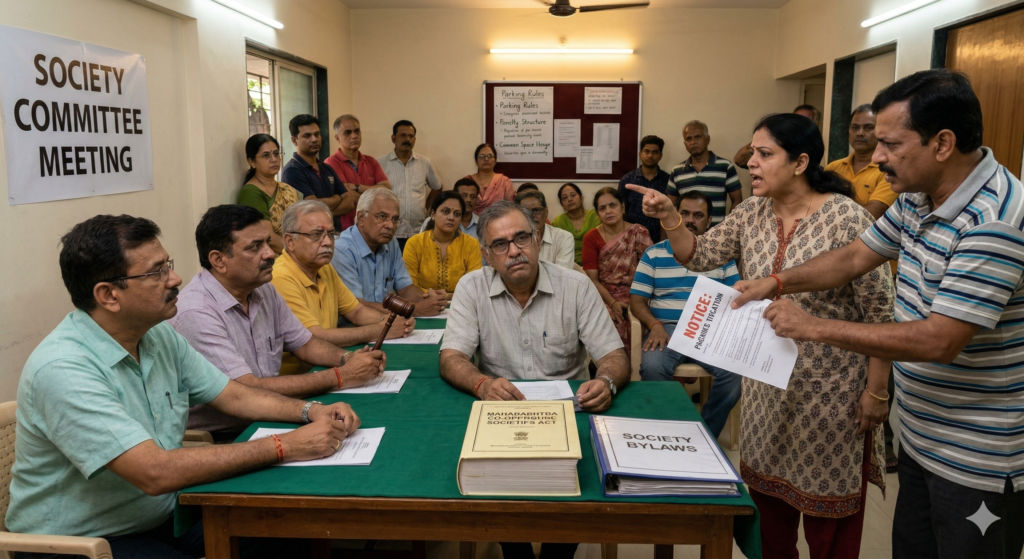
On one side, you have the honest, law-abiding residents who expect a clean, safe, and disciplined environment. On the other side, you have a vocal minority of members who treat every rule as an insult. Whether it is illegal parking, the encroachment of common spaces, or the non-payment of maintenance dues, these members are always ready to quarrel.
For the committee members, the situation is suffocating. They are residents themselves, serving on a voluntary basis. They are essentially doing a full-time, high-stress job for zero salary, only to be met with resistance from the very people they are trying to help.
The Bhishmas of the Building
In the context of housing society management, the committee members often mirror the “helpless seniors” of the Mahabharata. They know the housing society rules are necessary for the collective good. They see the “Adharma” of a neighbor blocking a fire exit or refusing to pay a penalty for a leaking balcony.
However, they are neighbors first and administrators second. Taking legal action for every petty matter is exhausting and often impractical. The “Kauravas” of the society—the non-abiding members—know this. They use emotional blackmail, social pressure, and sometimes sheer aggression to avoid penalties. This leaves the committee in a state of moral and functional paralysis.
Why Cooperation is the Only Way Forward
The primary reason housing society management becomes a “thankless job” is the lack of collective support. In the Mahabharata, the silence of the elders led to the destruction of the clan. Similarly, when the “Pandavas” of our society—the good, quiet residents—remain silent during a conflict, they indirectly empower the rule-breakers.
Here is why every member must cooperate:
Preservation of Property Value:
A society where rules are not followed eventually sees a decline in maintenance and aesthetics. This directly impacts the market value of your flat.
Safety and Security:
Fire safety rules and parking norms are not “suggestions”; they are life-saving protocols.
Preventing Volunteer Burnout:
If the honest and capable members of the committee resign out of frustration, the society will eventually fall into the hands of those who may not have its best interests at heart.
The Legal and Moral Gap
One of the biggest hurdles in housing society management is that the law cannot intervene in every small skirmish. You cannot call the police for every minor parking dispute, and moving the Co-operative Court for a five-hundred-rupee penalty is a waste of resources.
This “gap” is where the character of the residents is tested. If members do not accept notices or refuse to pay penalties approved by the General Body, they are not just fighting the committee; they are fighting the spirit of community living.
How can you help?
- Read the Bylaws: Ignorance is no excuse for rule-breaking.
- Pay on Time: Don’t make the committee chase you for funds that are used for your own comfort.
- Speak Up: In society meetings, support the manageming committee when they try to enforce a rule that benefits the majority.
Conslusion
Let us not turn our homes into a Kurukshetra. The Managing Committee is sparing their time and efforts for a job that brings more complaints than compliments. By cooperating, you aren’t just doing them a favor; you are ensuring that your own home remains a place of peace, not a battlefield.
In this battle of Dharma vs. Adharma, which side are you on? Choose to be a part of the solution, not the conflict.
Ram Niwas Bansal
“Building trust through discipline. As an IAF Veteran and certified Mutual Fund Distributor & Insurance Advisor, I help you secure your family’s future while you manage your property today.”
Disclaimer
The views expressed in this blog are intended for community awareness and fostering social harmony. The historical analogies are metaphorical. This content does not constitute legal advice under the Co-operative Societies Act for housing society management or any other local jurisdiction laws.
True . Very matured , committed and honest committee is required . In Ajmera Pristine , the earlier committee did excellent work . Generally Committee has time pass members with very little knowledge. People don’t understand the work of society . They join for time pass members. Selection of committee members and then unity among committee members is must . Serious people don’t join considering it is thankless job . I managed my earlier society for 20 years . Still they remember me