
Table of Contents
Introduction
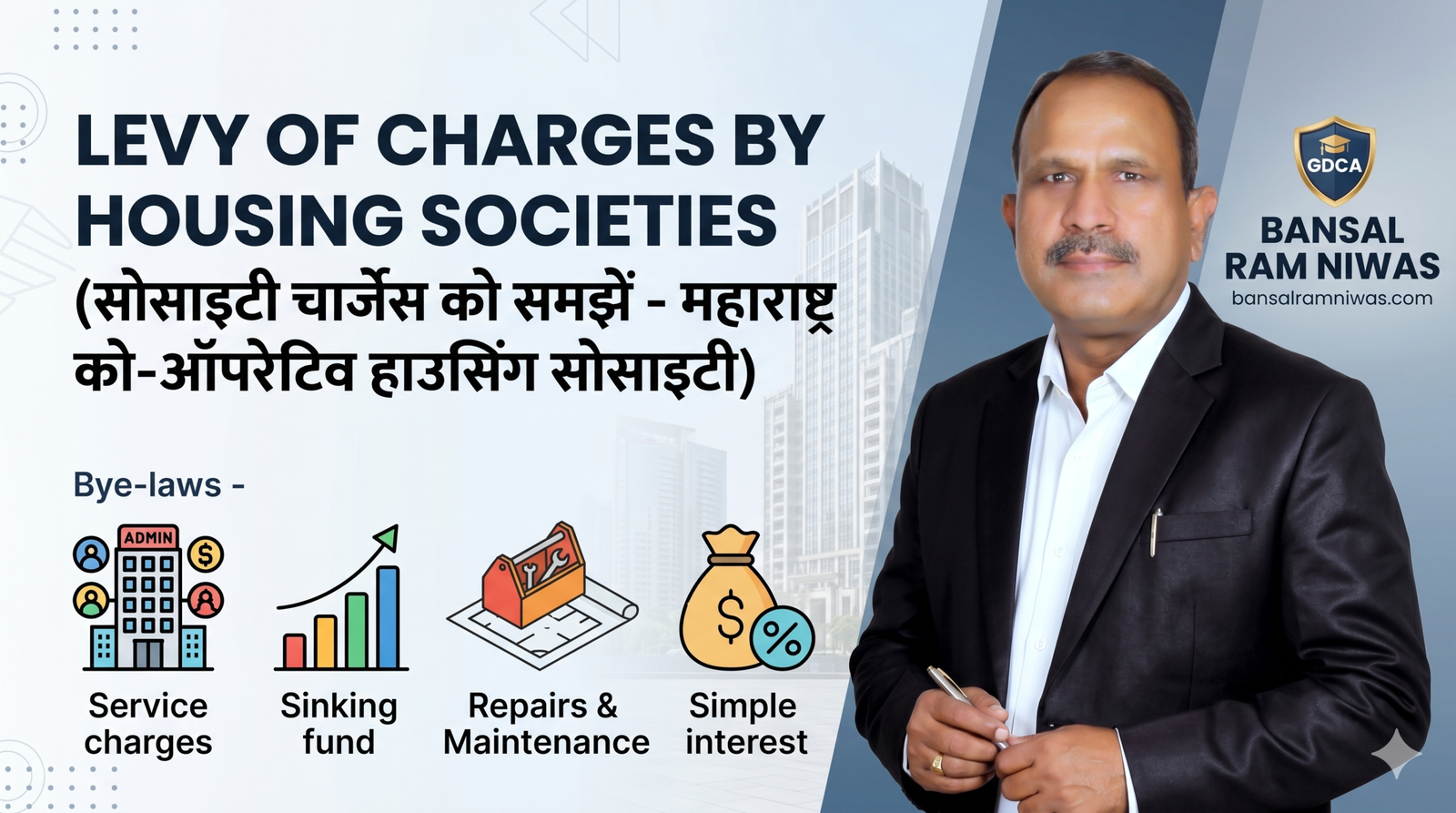
Levy of charges by Housing Societies: For many residents in Maharashtra, the monthly maintenance bill from their Co-operative Housing Society (CHS) can often seem like a confusing list of figures. However, these charges are not arbitrary. They are strictly governed by the Maharashtra Co-operative Societies Act and the specific Model Bye-laws adopted by the society.
⚡ Legal Update (June 2026): This article has been updated to reflect the Maharashtra Co-operative Societies (Amendment) Rules, 2026 (Notified on 18 June 2026), including the mandatory cap reducing maximum default interest from 21% to 12% per annum.
Using the official Bye-laws (specifically Sections 65 to 71), this guide breaks down what you are paying for, how it is calculated, and what happens if payments are delayed.
1. The Composition of Society Charges
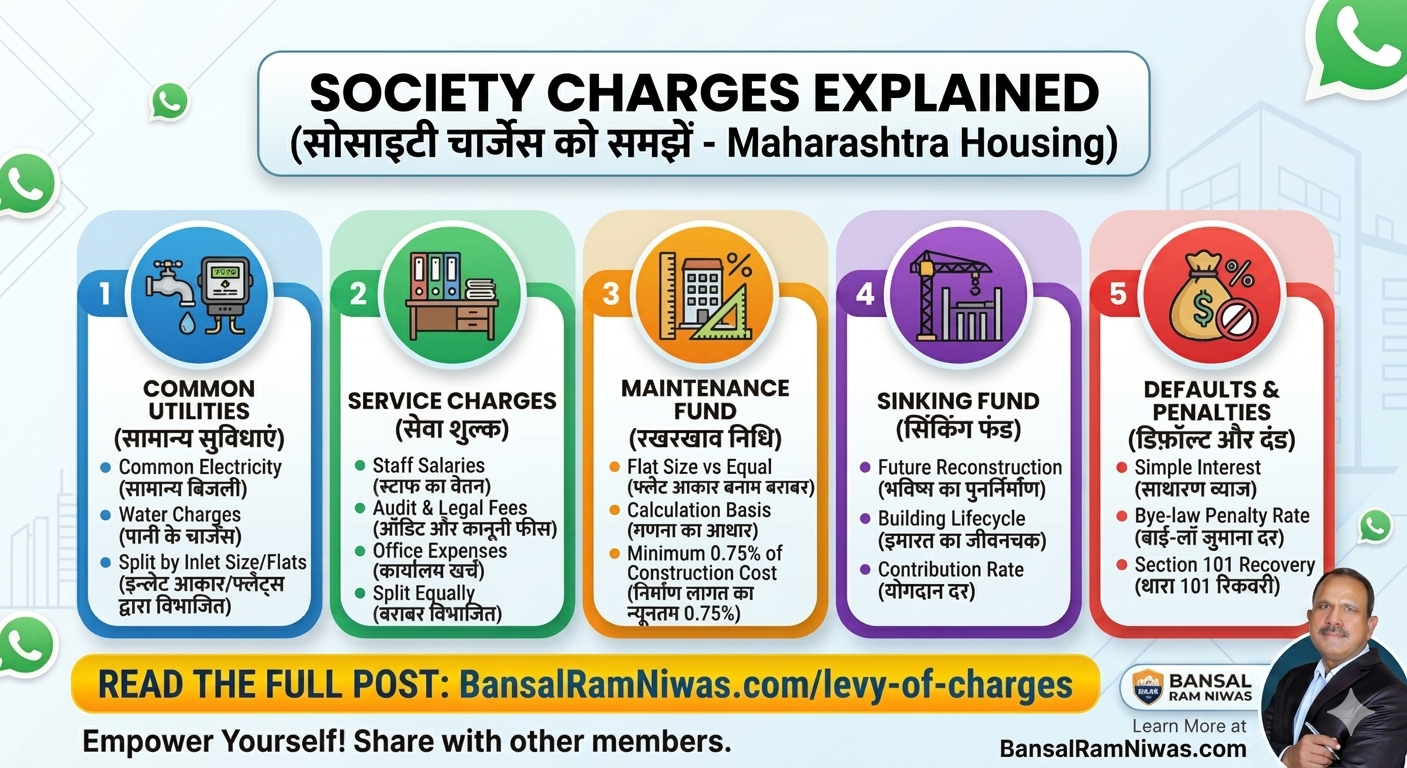
According to Bye-law No. 65, the levy of charges are categorized into several heads. These are collectively referred to as “Charges.” They include:
- Property Taxes & Water Charges: Statutory payments made to local authorities.
- Common Electricity Charges: For lights in corridors, pumps, and streetlights.
- Repairs and Maintenance Fund: For the upkeep of the building.
- Sinking Fund: A reserve for major structural reconstruction in the future.
- Service Charges: To cover the administrative costs of running the society.
- Lift Charges: Specifically for the operation and maintenance of elevators.
- Parking Charges: If you utilize a parking slot.
- Non-Occupancy Charges: Applicable if the flat is sublet or not occupied by the owner/family.
- Insurance, Lease Rent, and Education Funds: Specialized funds for legal and administrative compliance.
2. How are these charges calculated? (Bye-law No. 67)
One of the most common points of contention in a CHS is whether charges should be levied equally for everyone or based on the size (square footage) of the flat. The Bye-laws provide a clear “Apportionment” formula:
A. Levy of Charges based on Flat Size (Carpet Area)
- Property Taxes: As fixed by the Local Authority (e.g., BMC, NMMC, PMC) and for common areas on the basis of the carpet area of each flat/unit.
- Insurance Charges: Apportioned based on the carpet area of each flat (extra burden applies if a commercial unit increases the risk/premium).
- Lease Rent & Non-Agricultural Tax: Calculated based on the carpet area of each flat.
- Repairs and Maintenance: Fixed by the General Body, subject to a minimum of 0.75% per annum of the construction cost of each flat.
B. Levy of Charges divided Equally (Per Flat)
- Service Charges: Regardless of whether you own a 1BHK or a 4BHK, service charges are divided equally by the number of flats.
- Lift Charges: These are divided equally among all members, irrespective of whether the member uses the lift or not (e.g., ground floor residents must still pay).
- Election Fund: Divided equally as prescribed by the Election Authority.
- Education & Training Fund: Fixed at Rs. 10 per flat/unit per month.
C. Levy of Charges based on Usage/Criteria
- Water Charges: Based on the total number and size of inlets provided in each flat.
- Parking Charges: As fixed by the General Body.
- Non-Occupancy Charges: These cannot exceed 10% of the service charges (excluding taxes).
3. Deep Dive: What are “Service Charges”?
Many members ask what is included in the “Service Charges” component. Bye-law No. 65(g) defines this broadly to include:
- Salaries of office staff, watchmen, sweepers, and managers.
- Printing, stationery, and postage.
- Legal charges and audit fees.
- Traveling allowances for committee members on society business.
- Common electricity charges.
4. Repairs and Maintenance: Who Pays for What?
A common source of disputes is whether a leak or a crack is the responsibility of the Society or the individual member.
The society must bear the cost for:
- External walls, terrace, and parapet walls.
- Structural repairs of roofs of all flats.
- Staircases, lifts, and common passages.
- Compound walls, gates, and internal roads.
- Water pumps, storage tanks, and drainage lines.
- Leakages: Specifically leakages due to rain water or from common pipelines.
Member’s Responsibility
Any repairs not covered by the society’s list must be carried out by the member at their own cost. This includes internal leakages due to toilets or sinks within the flat. Members must intimate the society before starting such internal work.
5. Billing and Defaults
The Secretary is responsible for issuing a bill/demand notice to every member in accordance with the rules.
The Penalty for Late Payment (Capped at 12% p.a. as per 2026 Notification)
As per the Maharashtra Co-operative Societies (Amendment) Rules, 2026 (Govt Notification dated 18 June 2026, effective 30 June 2026), the maximum penalty interest a housing society can levy on overdue maintenance has been reduced:
- Maximum Interest Rate: Capped at 12% simple interest per annum (previously up to 21% p.a.).
- General Body Discretion: The General Body can fix a lower interest rate, but it cannot exceed 12% per annum.
- Simple Interest Only: Interest must be calculated only on the principal outstanding dues. Compound interest or charging interest on interest is strictly illegal.
What happens if you don’t pay?
- Notice of Default: If payment is delayed past the due date specified on the bill, the member is classified as a defaulter.
- Committee Action: The Secretary reports the default to the Managing Committee.
- Recovery Proceedings: The Society can initiate recovery proceedings under Section 154B-29 of the Maharashtra Co-operative Societies Act. The Recovery Officer can recover arrears as “arrears of land revenue,” which may lead to attachment of property in persistent default cases.
What happens if you don’t pay?
- Notice of Default: If payment isn’t made within the prescribed period, the member is deemed a “defaulter.”
- Committee Action: The Secretary brings the default to the notice of the Committee.
- Recovery Proceedings: The Society can initiate recovery proceedings under Section 154B-29 (Earlier Section 101he Maharashtra Co-operative Societies Act. This Section is particularly powerful as it allows the society to recover dues as “arrears of land revenue,” which can lead to the attachment of property in extreme cases.
💡 Instructions for Managing Committee: Copy the template text below, paste it into MS Word, fill in the bracketed details in bold, and print on official letterhead.
[Name of Co-operative Housing Society Ltd.]
Registration No.: [Insert Society Reg. No.] | Address: [Insert Full Address]
Ref. No.: CHS/2026-27/[Notice-No.]
Date: [Insert Date]
CIRCULAR / NOTICE
To: All Members / Flat Owners
Subject: Revision of Interest Rate on Overdue Maintenance Dues as per Govt Notification Dated 18 June 2026
Dear Members,
This is to inform all members of [Name of Co-operative Housing Society Ltd.] regarding an important amendment in the rules governing Co-operative Housing Societies in Maharashtra.
In accordance with the Maharashtra Co-operative Societies (Amendment) Rules, 2026 issued vide Government Notification No. Sanini 0321/C.R. 41/13-C dated 18 June 2026 (effective 30 June 2026), the Government of Maharashtra has capped the maximum simple interest chargeable on delayed maintenance/society charges.
Key Highlights of the Revision:
- Revised Rate of Simple Interest: The interest rate on overdue maintenance charges/bills is hereby revised from [Insert Old Rate, e.g., 21%] per annum to 12% per annum (Simple Interest) with effect from [Insert Effective Date, e.g., 1st July 2026].
- Simple Interest Calculation Only: In compliance with statutory rules, interest will be calculated purely on a simple interest basis on the outstanding principal balance. No compound interest or penal interest on interest shall be charged.
- Timely Payment Request: While the interest cap has been revised to 12% p.a., members are kindly requested to pay their monthly/quarterly maintenance bills on or before the due date specified on the invoice.
- Recovery Proceedings: Dues remaining unpaid beyond the extended grace period will attract simple interest at 12% p.a. and may compel the Managing Committee to initiate recovery proceedings under Section 154B-29 of the MCS Act, 1960.
This notice is issued by the order of the Managing Committee and shall be displayed on the Society Notice Board as well as shared via official communication channels.
Yours faithfully,
For [Name of Co-operative Housing Society Ltd.]
| ____________________ [Name of Secretary] Honorary Secretary | ____________________ [Name of Chairman] Chairman |
6. The Power of the Society
It is important to remember that once a society is registered, it becomes a Body Corporate. It has a “common seal” and the legal power to enter into contracts, sue, and be sued. The Bye-laws are the “Constitution” of the society, and while the General Body has the power to make certain decisions, they cannot pass resolutions that contradict the MCS Act or the Rules.
Conclusion
This is comprehensive guide to the levy of charges by co-operative housing societies. Living in a Co-operative Housing Society requires a balance of individual rights and collective responsibility. By understanding these Bye-laws, members can ensure they are not being overcharged, and Managing Committee members can ensure they are managing the society’s finances within the framework of the law.
Transparent billing and a clear understanding of “who pays for what” are the keys to a harmonious living environment.
Ram Niwas Bansal
“Building trust through discipline. As an IAF Veteran and certified Mutual Fund Distributor & Insurance Advisor, I help you secure your family’s future while you manage your property today.”
Frequently Asked Questions (FAQs) on CHS Maintenance Charges
What is the maximum interest a Housing Society can charge on delayed maintenance payments in Maharashtra?
As per the Maharashtra Co-operative Societies (Amendment) Rules, 2026 (Govt Notification dated 18 June 2026), the maximum simple interest a society can charge on default maintenance dues is capped at 12% per annum. Societies can no longer charge 21% or any rate exceeding 12% p.a.
Can a Housing Society charge compound interest on unpaid dues?
No. Under MCS Rules and Model Bye-laws, housing societies are strictly permitted to charge Simple Interest only. Charging compound interest (interest on interest) or imposing flat extra penalties on overdue amounts is illegal.
Can ground floor residents refuse to pay Lift Maintenance Charges?
No. Under Bye-law No. 67, lift operating and maintenance charges must be divided equally among all members, regardless of the flat location or whether the member actually uses the lift (including ground floor residents).
How should Service Charges be calculated—per flat or area-wise?
Service charges (which cover staff salaries, administrative expenses, common electricity, audit fees, etc.) must be divided equally per flat/unit, irrespective of whether you own a 1BHK, 2BHK, or 4BHK.
Which maintenance charges are calculated on a Square Feet / Area basis?
Charges that depend on flat size or valuation are levied on an area basis. These include Property Taxes and Insurance Charges, Lease Rent & Non-Agricultural (NA) Tax, and Repairs & Maintenance Fund (minimum 0.75% per annum of construction cost).
Can a society charge Non-Occupancy Charges if the flat is given on rent?
Yes, but with strict legal limits. As per Maharashtra Bye-laws and Govt Circulars, Non-Occupancy Charges cannot exceed 10% of the Service Charges (excluding statutory taxes and municipal fees). Charging higher amounts or flat arbitrary fees is non-compliant.
Are Non-Occupancy Charges applicable if a close family member lives in the flat?
No. Non-Occupancy Charges are not applicable if the flat is occupied by the owner’s immediate family members (such as mother, father, son, daughter, brother, sister, grandson, or granddaughter). It only applies when the flat is sublet to third-party tenants.
Who pays for rainwater leakage repairs—the Society or the Flat Owner?
If the leakage originates from external walls, terrace, main drainage lines, or common roof structures, the Society must bear the entire repair cost. However, if the leakage is internal due to plumbing/toilet issues within a flat, the individual flat owner is responsible.
What action can a society take against a persistent defaulter?
If a member fails to clear maintenance dues despite notices, the society can initiate recovery proceedings under Section 154B-29 of the MCS Act. The Registrar/Recovery Officer can issue a recovery certificate to recover dues as arrears of land revenue, which can ultimately lead to attachment and auction of the member’s moveable or immoveable property.
Disclaimer
This post is for informational purposes regarding levy of charges based on the Model Bye-laws and does not constitute legal advice. Always consult with a legal professional or the Registrar of Co-operative Societies for specific disputes.
Pingback: Power of 32 Ka Kamaal: Bhagavad Gita se Constitution tak
Pingback: Redressal of Grievances of Members in2 Housing Society
Pingback: Duties and Responsibilities of Members in 1 Housing Society