Table of Contents
Introduction: The Illusion of High-Pressure Productivity
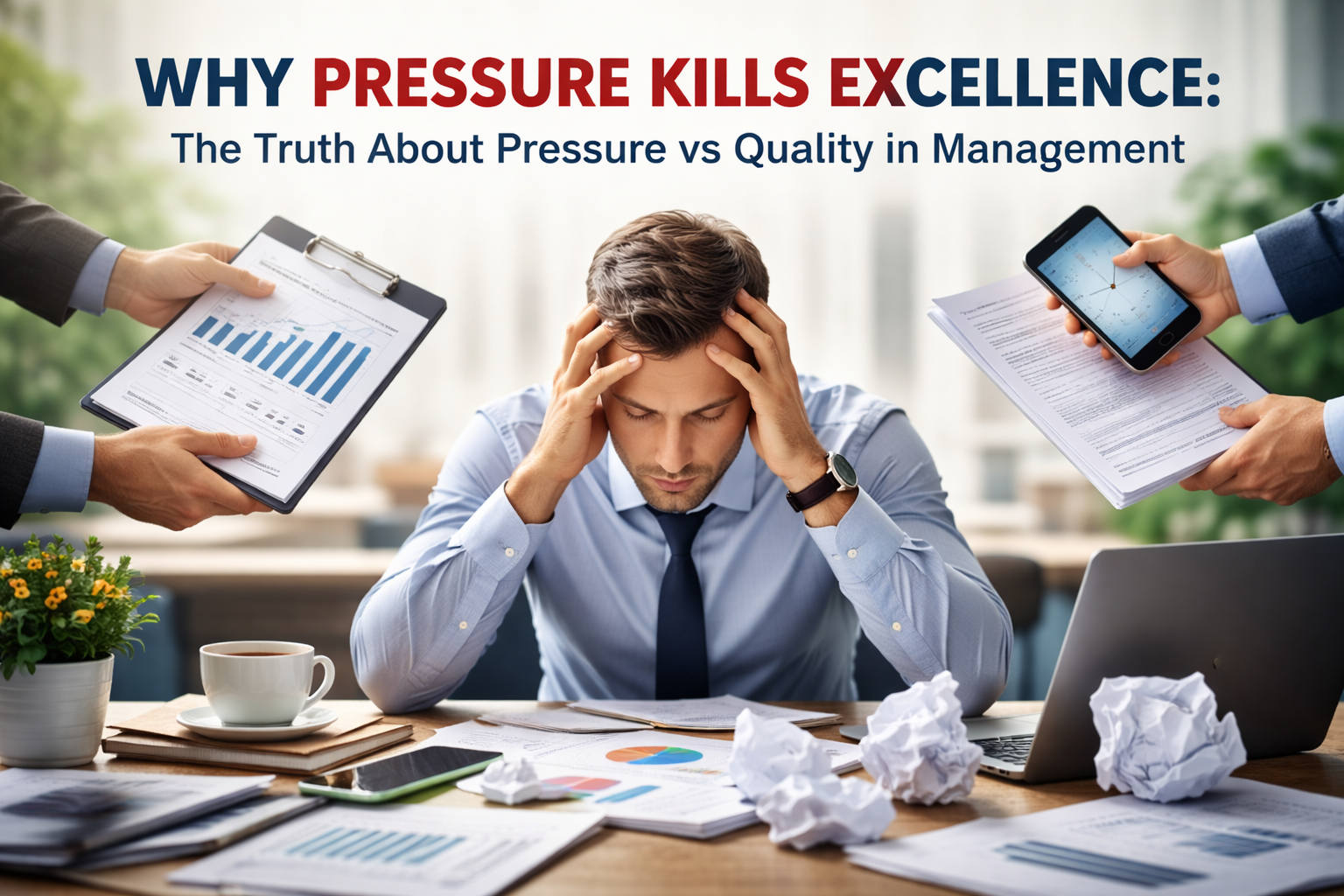
Pressure vs Quality in Management reveals a fundamental flaw in this logic. “In my years of service and health advocacy, I’ve seen that many leaders believe that the fastest route to a completed task is through maximum force. They operate under a “crank and grind” philosophy—thinking that if they apply enough heat, the engine will run faster.
While you can force someone to move their hands through intimidation or urgency, you cannot force them to bring their heart, soul, or creative intellect to the task. When we prioritize the “crunch” over the “craft,” we settle for mediocrity. As we explore the dynamics of pressure vs quality in management, we find that the cost of unnecessary force is often the very excellence we claim to seek.
Compliance vs. Commitment: The Management Divide

When discussing pressure vs quality in management, we must distinguish between compliance and commitment. Compliance is a mechanical response; the individual does exactly what is required to make the pressure stop—no more, no less. It is the “minimum viable effort” to avoid a negative consequence.
However, true Quality lives in the realm of Commitment. Commitment is a voluntary act where an individual brings their unique creativity, attention to detail, and personal pride to the work. Unnecessary force acts as a psychological block, causing the human brain to switch from a state of innovation to a state of survival. In a survival state, the worker isn’t thinking about how to make the project better; they are thinking about how to make the manager go away.
The Biological Toll: Why the Brain Shuts Down Under Stress
From a scientific and medical perspective, the debate of pressure vs quality in management is settled by human biology. High-pressure environments trigger the body’s “fight or flight” response. When a worker feels “pressurized,” their brain is flooded with cortisol and adrenaline.
While these chemicals are great for running away from a predator, they are disastrous for cognitive tasks. The Prefrontal Cortex—the part of the brain responsible for complex decision-making, fine motor skills, and quality control—begins to lose resources as the Amygdala (the fear center) takes over. In this biological state, a person is significantly more likely to:
- Make “silly” or repetitive errors.
- Overlook crucial safety or aesthetic details.
- Focus purely on the “deadline” rather than the “delivery.”
The Wisdom of the Bhagavad Gita: Action vs. Anxiety
For those who seek a more spiritual or philosophical understanding of pressure vs quality in management, the Bhagavad Gita offers the timeless principle of Nishkama Karma. This is the art of performing one’s duty (Dharma) without being paralyzed by the “fruits” or the anxiety of the results.
When a manager applies excessive, unnecessary pressure, they force the worker to focus entirely on the “fruit”—usually the fear of being reprimanded or the desperate need for relief. This shifts the worker’s focus away from the Karma (the action) itself. To achieve mastery, the mind must be fully absorbed in the work. Constant pressure shatters that absorption, making it impossible for the worker to enter a “flow state” where the best quality is produced.
The Hidden Costs: Turnover and Resentment
A “pressurized” environment might finish a single project on time, but it destroys the long-term culture of an organization or a housing society. The reality of pressure vs quality in management is that force leads to high turnover.
Talented individuals—those who have the skills to produce high-quality work—will not stay in a toxic, high-pressure environment for long. They will seek out leaders who respect their process. This leaves the “pressurizing” leader with a revolving door of inexperienced staff, which further lowers quality and creates a cycle where the leader feels they must use more pressure to get results. It is a self-defeating prophecy.
Practical Strategies for Leaders: Moving from Force to Influence
If you want to improve the balance of pressure vs quality in management within your own team, consider these shifts:
- Define the ‘Why,’ Not Just the ‘When’: People work better when they understand the purpose of the task. Meaning creates internal drive, which is more powerful than external pressure.
- Psychological Safety: Quality thrives when people feel safe enough to ask questions or admit they need more time to do a job correctly.
- The 80/20 Rule of Urgency: Reserve high pressure for genuine emergencies. If everything is “Top Priority,” then nothing is.
- Focus on Process, Not Just Outcomes: By supporting the worker’s process and providing the right tools, quality becomes an inevitable byproduct rather than a forced result.
Conclusion: Leadership Over Force
Real leadership isn’t about how hard you can push; it’s about how well you can inspire and facilitate. The balance of pressure vs quality in management will always favor those who lead with purpose, clarity, and respect.
Quality is the byproduct of a focused mind and a willing heart. You can buy a man’s time, and you can hire his physical presence, but you cannot buy his devotion or his excellence. Those must be earned through a culture that values the human being behind the desk. As we have seen, a person forced to produce will never produce a masterpiece. They will only produce a result—and in the long run, “results” without quality are worth very little.