
Table of Contents
Introduction
Do you think that You Are God? Whenever this profound question is gently brought up in conversations, almost 99% of people instinctively respond with a polite but firm “No.” In our everyday understanding, the word “God” immediately evokes the image of an omnipotent, miraculous, cosmic entity governing the universe from above. Comparing our humble selves to that ultimate reality feels like an act of misplaced ego or even a sin.
But do ancient spiritual scriptures, classical Sanskrit philosophy, and modern psychology actually view us as completely separate from the Divine? The answer is beautifully reassuring—not at all.
Today, let’s explore a simple, logical, and 5-step practical perspective that helps clear this doubt, allowing anyone to gently connect with this ultimate truth within just 2 minutes.
1. ‘The Milk Analogy’: Intensity vs. Property
Do you think that You Are God: To understand this deep philosophical concept, we do not need to dive into heavy, complex volumes of text. A simple, everyday example from the kitchen is more than enough to make it crystal clear:
- The Presence of Soul: You naturally accept that there is a living spark of consciousness or an Atma (soul) residing within you.
- Part of the Divine: According to timeless spiritual traditions, you also agree that this soul is an eternal part (ansh) of the supreme cosmic consciousness, the Parmatma.
- 10 Liters vs. 1 Liter of Milk: Now, imagine someone places 10 liters of pure milk in front of you. If you take out just 1 liter of milk and pour it into a separate vessel, what would you call the liquid in that smaller vessel? Naturally, you will still call it “Milk”.
- The Nature of the Component: If a small component of milk is still called ‘milk’ because of its inherent nature, then why is a component of the Divine (your soul) not recognized as ‘God’ by its very nature?
- Intensity vs. Property: Granted, the volume and overall power of 10 liters of milk are far greater than that of 1 liter. However, the intrinsic characteristics and properties of both remain exactly identical.
What the Divine does on a cosmic scale (Macrocosm), a human being is continuously doing through thoughts, choices, and actions on a smaller scale (Microcosm) within their own personal world. Now, Do you think that You Are God?
2. Then Why Can’t We Express Those Divine Powers? (The Lens & Sun Analogy)
Do you think that You Are God: This brings us to a very natural and thoughtful question—“If we are indeed parts of the Divine and share the same properties, why don’t we see those boundless results in our daily lives?”
Let’s understand this through a beautiful and gentle example:
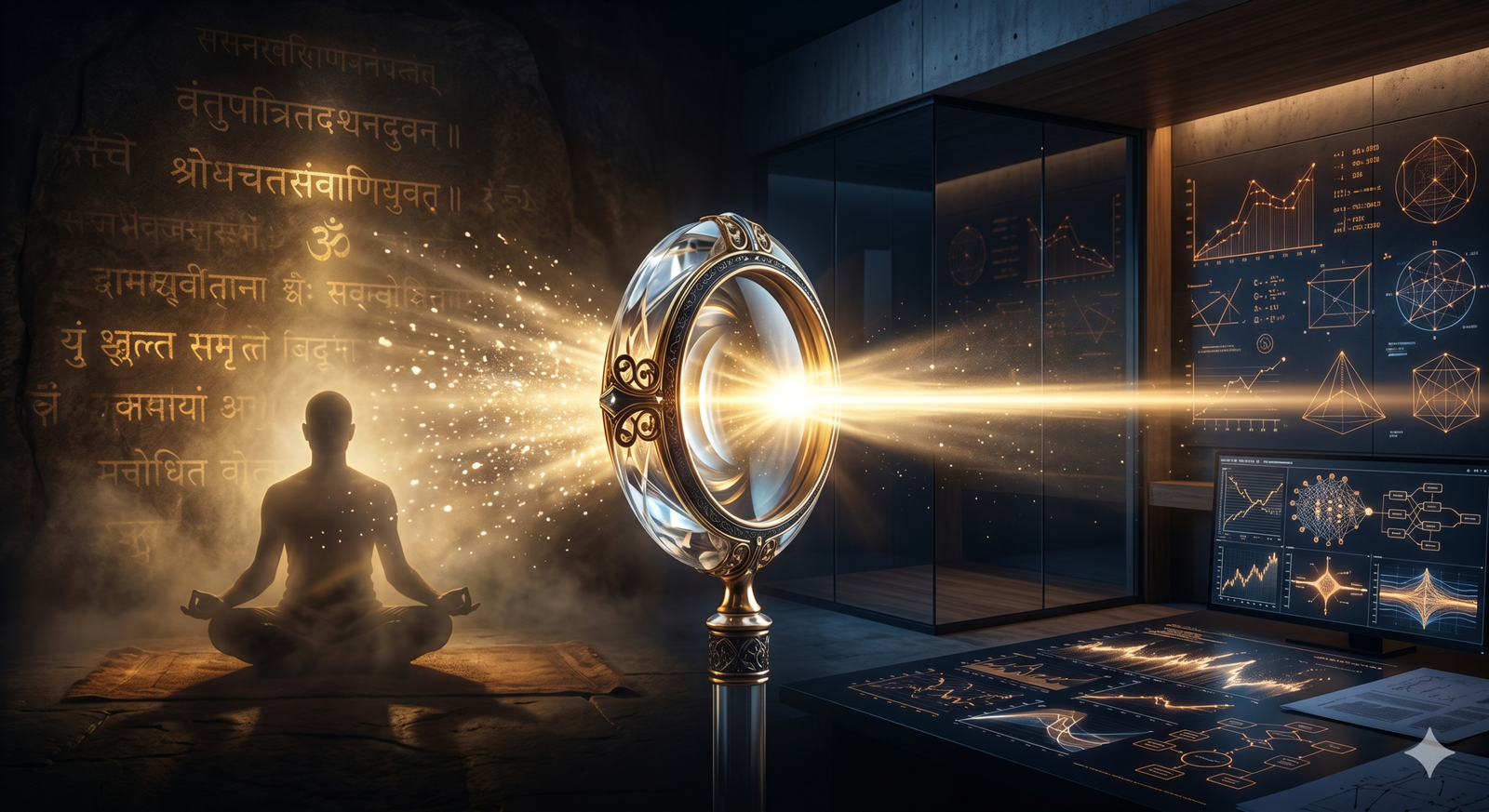
You and I walk out in the sun every day. The sun’s rays fall upon us, but nothing intense happens. We only feel a pleasant, comforting warmth. But, think for a moment—what happens if those exact same scattered rays of the sun are gathered and directed through a magnifying lens onto a single point? Within seconds, it can ignite a fire!
Why did this happen? The sun did not change, the rays did not change, and the total energy remained exactly the same. The only difference is that initially, the sun’s energy was scattered, making its immediate impact mild. But the moment that very same energy was gently channeled through a lens and focused, its power became concentrated enough to create a tangible, powerful effect.

This is precisely the human condition: Our inner potential and mental energies are currently scattered across thousands of mundane things at once. We are thinking in a hundred different directions. However, if we gently gather our scattered energy using the ‘lens’ of deep concentration and direct it toward a single goal with absolute Focus, the dormant powers within us awaken, making us capable of achieving remarkable things in life. Think now, Do you think that you are God?
3. Dormant Impressions (Samskaras): The Silent Phase and Awakening
Do you think that You Are God: People often wonder how someone can suddenly start sharing such deep, philosophical insights. The scientific and spiritual explanation for this was beautifully mapped out by Sage Patanjali in the Yoga Sutras (2.4):
अविद्याक्षेत्रमुत्तरेषां प्रसुप्ततनुविच्छिन्नोदाराणाम्
This ancient sutra reminds us that our thoughts, desires, and life experiences are never truly lost. They merely transition into a dormant (supta) state, resting peacefully in the depths of our subconscious mind (Chitta).
The phase in our lives where we might remain quiet, choosing to observe and deeply reflect rather than speak in a crowd, is actually a crucial ‘Observation Period’. During this silent phase, deep mental seeds are being gently sown. When these dormant impressions are met with maturity, real-world experiences, the study of profound texts like the Bhagavad Gita, and a welcoming environment, they naturally surface as beautiful philosophical wisdom.
4. The Harmony of the Bhagavad Gita and Modern Management
Do you think that You Are God: Navigating life’s daily complexities, aligning scattered thoughts, or managing structural challenges stems from this very self-awareness. What the corporate world labels today as “Root Cause Analysis” was championed by the global Quality Management guru, Philip Crosby, as a definitive problem-solving framework.
Crosby’s methodology gently guides us to:
- First, calmly acknowledge and define exactly what the issue is.
- Look past the surface symptoms to uncover the Root Cause.
- Evaluate all possible solutions mindfully.
- Execute the most suitable and preventive course of action.
This modern Western corporate tool mirrors ancient Eastern philosophy flawlessly. On the battlefield, Lord Krishna taught Arjun in the Bhagavad Gita to do exactly this—to look past emotional overwhelm, pull together his scattered mind, and approach his crisis with objective, calm rationality. When you marry the logical precision of the Sanskrit language with the practical psychology of the Gita and the analytical frameworks of Philip Crosby, every problem reveals its solution.
Conclusion
Do you think that You Are God: When this profound spiritual realization and calm management logic manifest through our actions, it builds an unshakeable reputation of trust and credibility in society. When people look at your track record and declare with absolute conviction, “If this task is in his hands, it will be completed beautifully,” it is a living testament to the focused, divine power of the soul aligned with truth. We are all the creators of our own destiny; all it takes is focusing our scattered light to recognize the peace and divinity within.
Ram Niwas Bansal
“Dedicated and highly qualified professional with a specialized focus on Cooperative Housing Society (CHS) Management and Legal Advocacy. Leveraging a strong technical background and an Indian Air Force veteran’s discipline, I provide end-to-end solutions for housing societies in Mumbai.
With a Government Diploma in Cooperation and Accountancy (GDCA) and a Diploma in Naturopathy, I bridge the gap between administrative excellence and holistic community well-being.
Disclaimer
Do you think that You Are God: This article is intended strictly for peaceful philosophical exploration, drawing upon the non-dualistic (Advaita Vedanta) concepts of ‘Aham Brahmasmi’ and practical corporate management frameworks. It gently aims to illustrate the boundless boundaries of focused human consciousness with utmost respect to all religious sentiments and personal faiths.
Frequently Asked Questions (FAQs)
Q1. Does realizing “I am an emblem of God” promote ego?
A: Quite the contrary. This philosophy dissolves the ego and creates immense humility. When you realize you are a fragment of the Divine, you simultaneously realize that every single human being standing in front of you is a fragment of the exact same consciousness. It leaves room only for mutual respect and empathy.
Q2. What is the core lesson behind the Sun and Lens analogy?
A: The lesson is that potential is universal, but scattered energy produces gentle, faint results. When we train our minds through focus, patience, or meditation to converge on a single point, we unlock the concentrated capability required to achieve seemingly impossible milestones.
Q3. When do dormant thoughts surface according to the Yoga Sutras?
A: Hidden impressions and subconscious seeds surface as profound wisdom when they are exposed to the right catalyst—such as intellectual maturity, life experiences, and a supportive environment for expression.
Q4. How does Philip Crosby’s technique apply to community or housing society management?
A: It allows a manager to look at structural glitches or interpersonal disputes objectively without getting swayed by temporary emotional friction, allowing them to fix the actual systemic root cause permanently.